Blog

  • An Evening of Storytelling and History: A Beneath the Sicilian Stars Signing at Vroman’s Bookstore

    An Evening of Storytelling and History: A Beneath the Sicilian Stars Signing at Vroman’s Bookstore

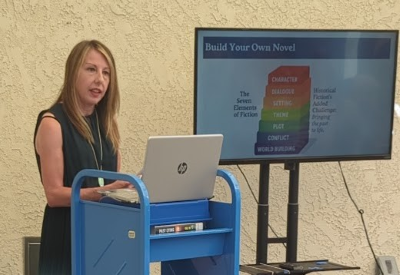
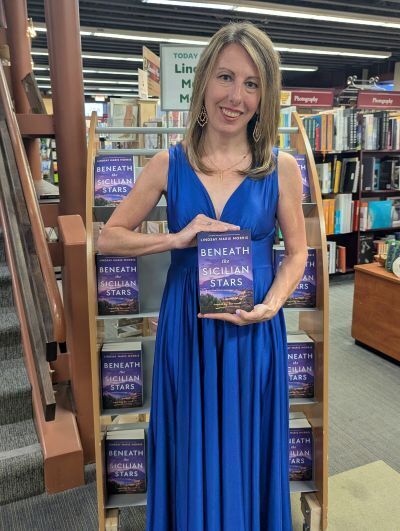
    Thanks to all who braved the Los Angeles traffic to attend my Beneath the Sicilian Stars signing and discussion on September 8 at Vroman’s Bookstore in Pasadena, California.


    The book is rooted in a rarely told chapter of California history: the Italian Americans who endured curfews, property seizures, forced relocation, and internment during World War II. These stories have long remained in the shadows. 

    I shared how this historical novel came to be, explaining that my research for my debut, The Last Letter from Sicily, led to my discovery of Una Storia Segreta, a collection of essays and testimonials by Italian Americans affected by World War II restrictions and imprisonment. The book’s editor, Lawrence DiStasi, dedicated the last three decades of his life to bringing these stories to light, helping convince President Bill Clinton to pass the “Wartime Violations of Italian American Civil Liberties Act,” which was signed into Public Law 106-451 in November 2000. I was fortunate to have had the chance to meet and interview Mr. DiStasi just weeks before he passed away in May of this year.


    Vroman’s holds a special place in the historic events portrayed in Beneath the Sicilian Stars. During the war, the bookstore donated and delivered books to Japanese American internees, offering comfort and connection in a time of hardship. Holding this event here felt both literary and deeply historical, honoring Vroman’s legacy of community support.

    I’m grateful to everyone who attended and sent well wishes. It was touching to see former colleagues alongside new faces in the audience. Everyone you meet influences your journey, and sharing this night with such an engaged group was an honor.


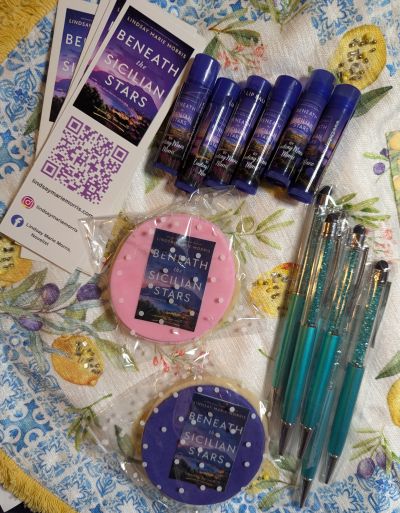
    Thank you to Storm Publishing for releasing both of my books to the world this year, and to the small businesses who helped make the evening memorable with customized swag: vegan book-cover cookies from Dottie’s House of Sweets (@nicoooo8), lip balm from Bulk Apothecary, and bookmarks from Platinum Print USA. Thank you, too, to Carlie aka ShesBecomingBookish, who shared her own recap of this event on TikTok.


    I appreciate all of the support I’ve received from those near and far. It means the world to this author.


    Thank you for reading and watching. Check out my upcoming events and appearances


  • From Porticello to Porticello Ristorante: Mario Sanfilippo Brings a Taste of Sicily to Massachusetts

    From Porticello to Porticello Ristorante: Mario Sanfilippo Brings a Taste of Sicily to Massachusetts

    Like my Sicilian grandparents, Mario Sanfilippo’s family emigrated to Milwaukee from Porticello, Sicily, in search of a better life. After his uncle passed away, his grandparents relocated to the Boston area. Mario and his family joined them when he was 10, but always kept a piece of his Tyrrhenian seaside hometown in his heart.

    His love of his mother’s Sicilian cooking inspired him to seek work in restaurants, starting from a young age. He was just 11 when he got a job at a pizzeria, where he bused tables and washed dishes. Even while pursuing a bachelor’s degree at the University of North Carolina, where he played soccer, he would pick up shifts at a local restaurant. He’d continue to do so, even while working in the banking industry.


    “Somehow, I always ended up at a restaurant,” Mario says. 


    In 1992, he left his job to open Mario’s Trattoria, an Italian eatery in Dorchester, right in the heart of Boston’s Irish section. Six years later, he opened Porticello Ristorante in South Easton, Massachusetts, south of Boston and east of Rhode Island. He shared more about his passion, journey, challenges, favorite dishes, lessons, and what he hopes customers take away.


    What do you enjoy most about running a restaurant?

    It’s social. You’ve got instant gratification. You give somebody a good product, and they let you know about it. You develop a lot of different relationships along the way, whether it be vendors or patrons. I combined my accounting and all my background in business, and it was helpful opening up a restaurant and figuring out what would work numbers-wise and how we would do it. It’s a combination of things, but I enjoy making people happy, which is part of it.


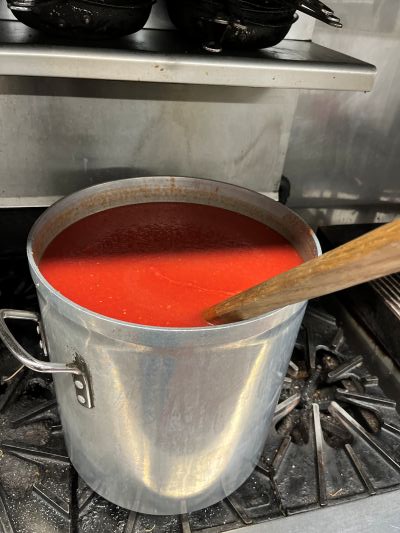
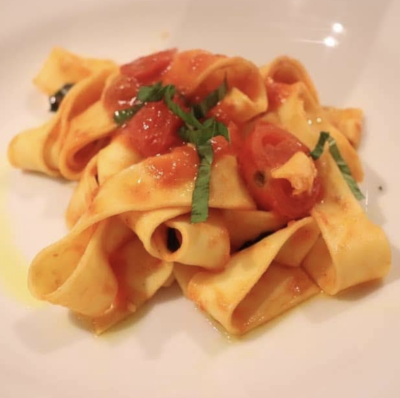
    Porticello’s housemade sauce 


    Was there a pivotal moment in your culinary career?

    It was in 1998 when I went from a casual restaurant to a casual fine dining restaurant, where I had to step up my game and surround myself with different talents. I threw myself into it at that point. You think you know a lot, but you’re always learning. When I went into the fine dining end of it and became a pretty good chef, I got to where I could handle it. If that key person decided to leave, I knew I would be OK and could move forward.


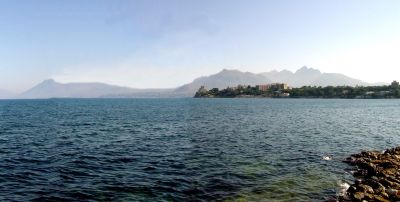
    View from Porticello

    What inspired you to name the restaurant after your birthplace?

    Porticello will stay with me for the rest of my life. I lived there only for 10 years, but I consider myself very Italian. I stayed connected to the Italian people here in the Boston area and played soccer with all my Italian friends growing up. It kept me watching RAI (Radiotelevisione italiana) on television because my mom and dad could hardly speak English. So, growing up with all that, plus Porticello had a nice ring to it. It’s where I was born.

    We incorporate certain things into our dining. We’re primarily an American Italian restaurant, but we make the arancini the way they do over there. I make panelle and incorporate them into antipasti. I also do pasta.


    We incorporate these things and don’t miss a beat when we have the Italian Italians that come and dine. They know that we’re authentic. 


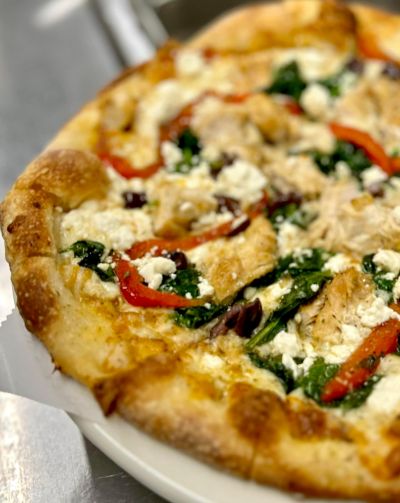
    Porticello serves pizza and pasta, as well as arancini and panelle.


    What challenges have you faced?

    Most people think about Umbria, Emilia-Romagna, or Tuscany. So it’s kind of tough to push Sicilian food because they see it as more like peasant food. They don’t look at Sicily the way they look at Tuscany. So it’s a risk when you go into business if you want to tell people that you’re Sicilian and push your food. There is still this discrimination. 


    That was the biggest challenge because you could easily embellish whatever write-up you come up with and not mention Sicily, just talk about Italian food and touch upon all the different regions. It’s easy to do that. It’s challenging to tell people you’re from Sicily, but it came easily to me. I’m proud of where I come from, Porticello.


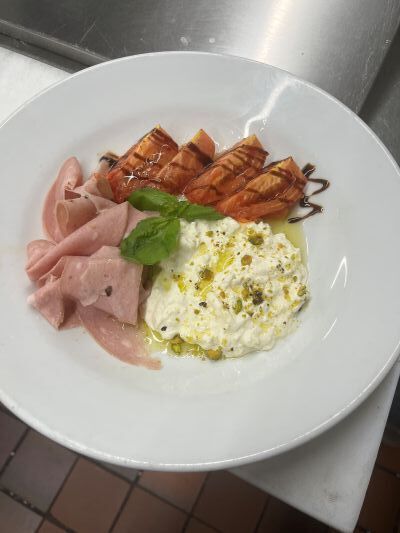
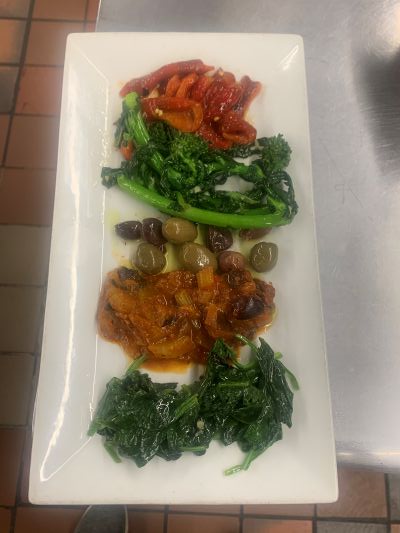
    A vibrant antipasto plate


    What are your favorite dishes to serve and why?

    I like to cook with a lot of seafood. I like doing Chilean sea bass and cooking with meats, whether a sirloin, filet, or rack of lamb. Those are staples at Porticello. But I also like cooking Sicilian. I like making a salad with fennel, tomatoes, olives, and simple things like that. I like simplicity, so when I grill my seafood, I complement it with a nice salad or potato. 


    What lessons have you learned from being in the restaurant business for decades?

    Don’t stand still because you’ll get run over. That’s the biggest lesson. Don’t worry about what you’re doing and not what other people are doing. Worry about putting yourself first. Don’t worry about the competition; worry about what you need to do to make yourself better. And it’s worked financially. I mean, we get hit like everybody else. When there’s a downturn in the economy, everybody feels it. We feel it. But if you’re on good footing, you should be able to move forward.


    Come for the flavors; stay for the experience.


    What do you hope your customers take away from their dining experience at Porticello Ristorante?

    I care about them and what I put out, and want them to return. But they know I’ve made a lot of friends along the way, and they know what I’m all about. I’m not about the money; I’m more about the experience.


    If you enjoyed this article, consider subscribing to my newsletter for more content and updates! 

  • Forno Bakery: A Story of Healing, Heritage, and Heart

    Forno Bakery: A Story of Healing, Heritage, and Heart

    For more than 20 years, Melissa Sepulveda enjoyed a photography career. She took family portraits and provided shots for the advertising department of a high-end handbag company. But everything changed on Mother’s Day weekend of 2019 when she learned she had breast cancer.
     

    She chose not to share this news with her mother, who was not feeling well, even after scheduling an August mastectomy. As it turned out, her mother was hospitalized in July, a stay that lasted until September. Melissa had her operation on a separate floor in the same hospital wing, but still, she kept her diagnosis from her mother. She knew it would make things more difficult.
     

    After she was discharged from the hospital, Melissa spent two weeks recovering before returning to her mother’s bedside, where she spent her mother’s final days on the pull-out chair until her mother passed on September 16. She was devastated, exhausted from her own recovery, and struggling to make sense of what life looked like without her mother. Her father was already gone. 
     

    Melissa turned 50 that December and decided that after such a harrowing spring, summer, and fall, she needed to celebrate. She held a holiday open house without telling anyone it was her birthday—just an opportunity to have fun, relax, laugh, and sing together. 

    One of her friends gave her a book called Baking Bread for Beginners. The two had fantasized about opening a cafe.

    Melissa didn’t open the book until January, when she made her first loaf of bread. As she kneaded the dough, she was struck by its texture, which, funnily, reminded her of her mother and grandmother.


    Working with dough reminds Melissa of her mother and grandmother.

    “My mother and grandmother both had very soft upper arms, and as kids, my cousins, siblings, and I loved holding on to those arms,” Melissa remembers. “We would call them dough arms, which is what that dough felt like.”

    Kneading it was therapeutic, as was the smell of the yeast, which brought her back to her Sicilian grandmother’s kitchen. From then on, she couldn’t stop baking.

    Today, as the owner of Forno Bakery in Wareham, Massachusetts, on the southern outskirts of Greater Boston, Melissa bakes and sells breads, cannoli, quiches, focaccia, fonuts (a hybrid of a donut and focaccia), and more. 

    We discussed her influences and how she took her baking from personal therapy to a community-oriented business. She shared her challenges, goals, and what she hopes to deliver.

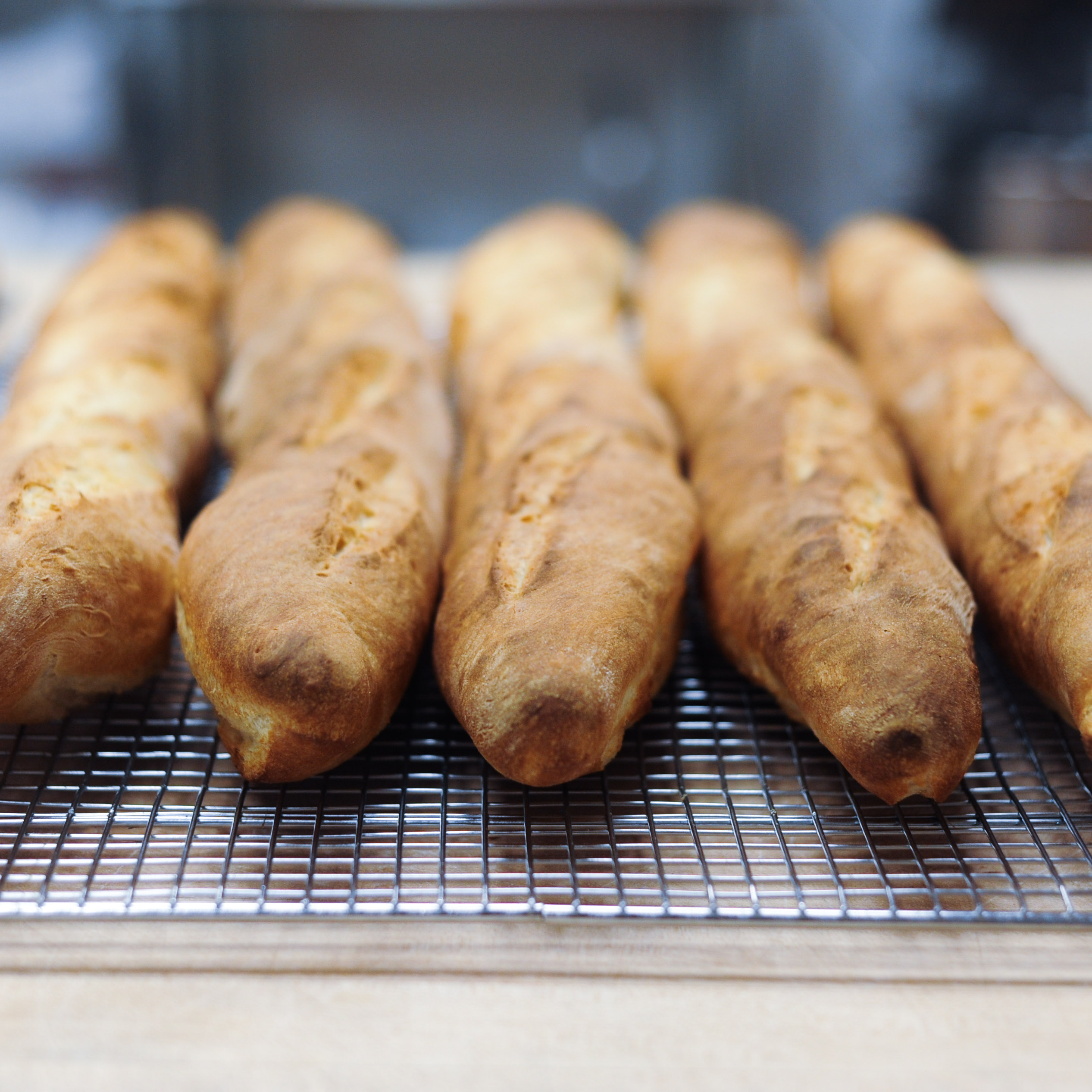
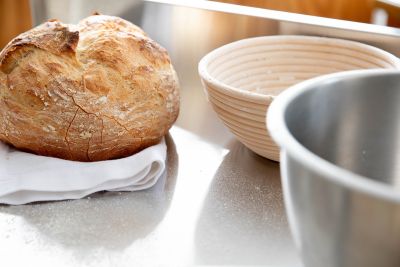
    Forno Bakery loaves


    How did your grandmother influence your passion for baking?
    I consider myself a generationally taught baker, because it’s nothing that you can learn in school, or you can learn from a book. It’s really your hands-on experience. It was with my grandmother as soon as I could hold some dough. Without knowing it, I was experiencing what that texture felt like, and I liked to feel that. 

    I remember distinctly loving the smell of yeast at a very early age. Some people are kind of offended by it, but those two things really resonate with me. 

    When I bake now, it’s different. It’s a feel. It isn’t just in my hands. It’s almost meditative. It’s extremely therapeutic and comforting because I’m returning to my grandmother and mother, who made things differently. 

    My grandmother loved to take the time, and she could embroider. She was very, very talented and very creative. When she passed away, we found all these little scraps of paper with different ingredients written on them randomly around her kitchen. They were notes for herself about something she was working on or something she had added as she was baking or making whatever it was. We just realized at that point just how smart she was with very limited resources. 

    You have to think about how she arrived on Ellis Island with her little sister in the early 1900s. She was nine years old, one of many children, and a lot of them were still back in Italy. When they came over, she actually had conjunctivitis, so she was separated from her mother when they landed. 

    My mom and I went to New York and visited Ellis Island, and just to imagine that my grandmother walked through there… It wasn’t just a setup of chairs and suitcases off to the side. She couldn’t speak English and was being separated from her mother in a different country. 

    She was a child and did not know what was happening. I can’t imagine the fear or the anxiety that she must have felt during that time. The next day, she was reunited with her mother, but the idea of that made me so emotional as I stood in that building.

    Eventually, all the other family members slowly came over, and everyone was here in Massachusetts. They started in Mansfield, Massachusetts, and then ended up in Quincy, Massachusetts. 

    Melissa’s grandmother’s home in Sicily

    My grandmother met my grandfather and married when she was 16. She made her wedding dress, which is just so beautiful. Her sister used to create a Maypole like the one they use for the May Day celebration. She would make paper dresses for all of the girls. You would not even know that they were paper—the craftsmanship, the detail, and all that were so relevant.

    I grew up with her. She and her sister were very close, and her sister married my grandmother’s husband’s brother. So we were so interconnected with this huge family. 

    I’d watch my aunt crochet, and my grandmother embroider, bake, make things, and just go about her day. They were always busy doing something productive and very clean. 

    My mother liked to do everything very quickly. She did not enjoy the process, whereas I enjoyed it. I really have that connection, and my mother always wanted to make it as fast and efficient as possible.

    As a teenager, I remember wanting to make and decorate some cookies. I think William Sonoma had just come out, and they had these giant Christmas cookie cutters. So I got the cutters and told my mother I was going to put one at every place for Christmas dinner. I said, “I need 20, so we’re going to decorate these. This is what you do.”

    My mother’s cookies ended up looking like something a 3-year-old would do, because again, she just did not have the patience. And I was so into the actual craftsmanship, making, and experience.  

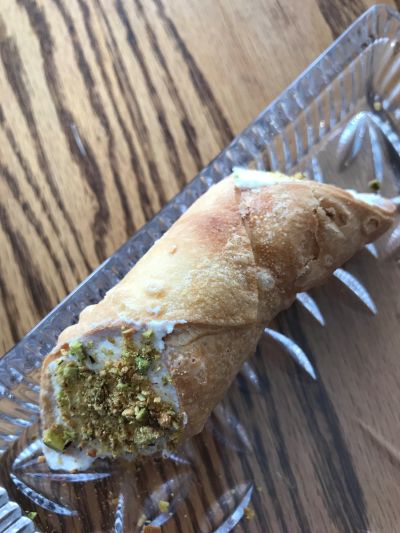
    Forno Bakery cannoli


    What did you bake with your grandmother?
    My grandmother made homemade cannoli. She made the shells. Obviously, I wasn’t allowed to fry the shells or anything like that, but we would make that.

    We made polenta on the first snow. She’d get out a huge board that sat on the kitchen table, and then she would spread the polenta all over the board. The sauce would go on top of that, and the meatballs and sausage would go on top of the sauce. I would help her stir and spread it out on the board. 

    When we made biscotti, I’d help her roll out the dough. That wasn’t too often because she was up very early, but she did live around the corner from my house, so I could visit as often as I wanted. 

    When she would make things, it wasn’t even like she sat me down to say, “OK, now this is how you do this.” It would be mostly from observation and her understanding of taste and smell. She’d say, “Can you smell the salt in the water? That’s how you know to put enough.”

    You would just see the amounts of the ingredients that went in. I don’t even remember anyone teaching me how to make our family’s tomato sauce, but I just did it over the years. 


    I made bread one time, and she had come over. I was living at home with my parents, and she came over to the house, and I said, “Ma (we called her Ma), I made bread.” 

    She kind of looked at it with a discerning eye, which was odd for her. She was very gentle and very kind. She wasn’t your stereotypical Italian grandmother with a rolling pin in their hands and yelling or swearing. She wasn’t like that at all. I asked, “Do you want to taste it?” and she said, “OK.”

    She took a little piece, and the bread had been sitting on the kitchen table under the fan. As it was cooling, it made the house smell good. But I didn’t realize that the fan was blowing on it, making the crust nice and crispy. 

    She was out of her mind with excitement and joy. As soon as she bit into it and it crunched in her teeth, she looked at me and said, “This is delicious!”

    She took some home, and that had to be the biggest compliment from my grandmother.


    Melissa’s boule loaves are Forno Bakery’s best sellers.


    What inspired you to launch Forno Bakery?

    One day, I made 14 loaves out of my little kitchen oven, and my husband was like, “What do we do with these? I love bread, but this is getting a little silly.” And I said, “I’ll just post on Facebook, ‘Whoever needs bread—I made extra, come and get it.’”

    They did. Then I did it again, and they came and got the bread again. My friends were saying to me, “You can’t do this. You can’t just give away the bread. You need to sell the bread.” And I said, “I’m not a baker.” And they said, “We think you are a baker.” 

    I ended up charging like $5 for a loaf. I didn’t do any numbers or anything like that, but it started to catch on really quickly because then COVID came, and people were coming to my door, buying bread, and just finding that sense of community. We were all reaching out to each other. 

    My local town market, a general store, wanted to carry my bread, so I sold it to them. It just really caught on like wildfire. But I was just working out of my little oven in my kitchen, finding myself working from five o’clock in the morning until about seven o’clock at night, passing out in bed, and getting up and doing it again. 

    I was like, “I can’t keep doing this. This is silly.” So, I had to make a decision. I would either go forward or stop because I was at a crossroads. 

    One dog walk changed everything.

    We got a COVID dog for my son when he wanted a puppy, and one day, I was walking the dog. The town I live in is very Norman Rockwell, unlike anywhere I’ve ever experienced. Everyone says “Hi” to everybody. Everybody’s going to take care of you. And that’s just kind of how we roll. 

    So I was walking the dog, and I met up with a neighbor, who said, “My wife used to go around the world teaching people how to set up bakeries.” And I said, “Oh, wow. Well, isn’t that a coincidence? That’s amazing.”

    He said, “She’s got this commercial oven she wants to give you. It’s just hanging out in her warehouse.” I said, “I don’t have a location. It’s just in my house, and I’m trying to decide which way to go.” 

    I just felt like everything in the universe was pointing me toward continuing, and that my mother and my grandmother were part of this. Like, “You need an oven? We’ll find one for you.” Your neighbor, two doors down, whom you didn’t meet until you got the dog. They have a commercial oven. 

    When he said this, I kind of laughed it off and thought, “Nice guy; that’s sweet.” I didn’t do anything about it. 

    A few months passed, and he said again, “Amy really wants to give you that oven.” I was like, “OK. I’m going to go and find someplace to put this oven.”

    Fast-forward: One of my closest friends did not like her executive job, didn’t know what she was going to do, and said, “I want to come on board and help you open up a brick-and-mortar. I’ll do whatever you want.” So, we found a spot in the next town over, and that was almost four years ago, last December. 

    She quickly realized that baking was not her passion and helped me get off my feet for the first six months to a year, after which I was on my own. 

    Owning a business is not an easy feat, but every time I encounter something that would deter me, something else counteracts it. Like the gift of the oven, which tells me, “Keep going.” So, I continue, and I kind of laugh to myself because I’m selling all of the things that my grandmother taught me or made, and we all still make in my family.

    The cannoli cream is very specialized for what we do. There are the anise pillows and biscotti, raspberry bars, lemon squares—all those things. I never realized what a gem they were, how special they were, and that other people weren’t growing up having those as good or so consistently. 


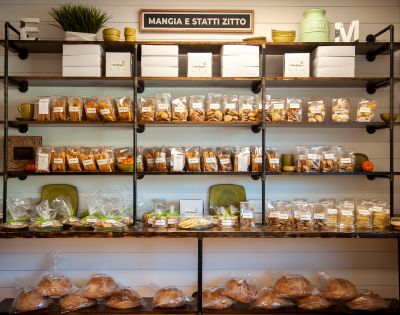
    Shelves full of Forno Bakery goodies


    What are your goals?
    For so long on this journey, I was just riding the wave. And now that it’s established and people know me, people recognize me outside of my town from different silly videos on social media, or they know the name of the bakery. I am floored. It made me kind of rethink, “Am I going to continue this?”

    I would love to continue expanding, have management and departments, and have my own free-standing building where I could have a section with classes and a little section for retail. So, ultimately, that’s what I would like: to have my own spot.

    Quality ingredients and small-batch, hand production: Forno Bakery

     
    What do you hope to share?

    I’m not a huge baking company where things have to be commercialized and really huge baked. Everything is still small batches and very nice, good-quality ingredients, and everything comes from what I know. I get so much joy from giving somebody something I made and seeing them so thrilled and happy about it. That is returning a feeling of joy to me, and I think without that, I would be very, very lost because that’s where I got my joy. 

    Don’t get me wrong; I love my children, but the core of my joy was the security I had from my parents. I remind myself that my mother had to go through losing her mother, and her mother had to go through losing her mother. They taught me along the way how to deal with this. 

    The inside is different from what you see outside, so I always try to fix that inside piece by selling our goodies. 


    If you enjoyed this article, consider subscribing to my newsletter for more content and updates!

  • Italian American Community Center of Rochester: A Home for Tradition, Celebration, and Connection

    Italian American Community Center of Rochester: A Home for Tradition, Celebration, and Connection

    Since its groundbreaking in 1999, the Italian American Community Center of Rochester has been a celebration destination. The three-story building offers 27,000 square feet of floor space with ballrooms, bocce courts, an Italian-style bar/cafe, offices, a boardroom/classroom, and an area for dancing. 


    Locals have booked the facility for weddings, proms, corporate events, engagement parties, birthday bashes, showers, reunions, fundraisers, and quinceañeras. They can also attend IACC events ranging from St. Joseph’s Table and Festa Italiana to the Ferragosto Picnic and Christmas Gala. 


    It’s a place to gather for food and fellowship while tapping into the traditions and history of immigrants from Italy’s boot and islands. And no matter where you come from or your family history, “Everyone is Italian who walks through this door,” says IACC Office Manager Cassandra Pettrone. 


    I spoke with Cassandra and her colleagues, Event Coordinator Erin Noll and Event Coordinator/Cook Sonia Amadio, about their nonprofit organization’s efforts to preserve Italian culture, provide a sense of community, and reach younger generations.


    How does the IACC maintain its ties to culture while reaching the community?

    Erin: We have a strong membership. They’ll have their family events here. We have biweekly luncheons where original members come together and prepare the meal with Sonia. We do the St. Joseph’s Table, a picnic in June, Ferragosto in August, and the Gala every December. At this past year’s Gala, we were able to donate to a local organization called It’s About Caring for Kids.


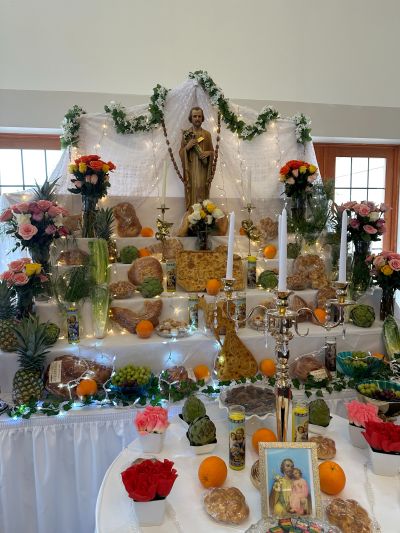
    Italian-American-Community-Center-of-Rochester---St--Joseph-s-Table---Close-Up-View.jpg
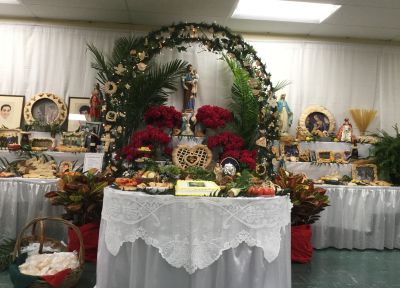
    A past IACC St. Joseph’s Table. Learn more about this tradition here.

    How is IACC engaging with younger generations?

    Sonia: We’ve had Italian classes in the past. We’re actually looking at doing cooking classes—Cooking with Nonna—in the future.

    It’s hard to pull in the younger generation because they’re involved in many different activities and sports. For my generation, it wasn’t that way. Our parents had a lot more time to bring back to the community, to be here, and to do so many things for the Italian American Community Center. So, we’re looking into activities to bring them back, where they can engage with their grandparents or parents. 


    Cassandra: I continue to do this type of work in my adult life because of my background. I have always felt very connected with my heritage and where my family came from in Agrigento, Sicily. I took Italian classes from seventh to eleventh grade in high school. So, part of it is finding people who care about their heritage, culture, and continuing traditions. 


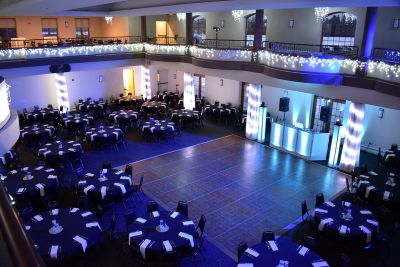
    Italian-American-Community-Center-of-Rochester---Nixon-Peabody-Corporate-Event---Ballroom-View.jpg
    IACC caters and hosts weddings, banquets, corporate functions, and school events.

    What experience do you hope to share?

    Erin: I did not grow up Italian like Sonia and Cassandra. So for me, it’s nice. I love learning about the different traditions and the culture. I try really hard to learn the language. I love hearing the stories of how things happened back when members lived in Italy and stories of coming over here. My absolute favorite thing is just learning their history and how everything came about—and then seeing them come together and how everybody’s sauce is made. It’s like a big family where we can all get together and share stories and feel welcomed.


    Sonia: Most members have been here since the very start, so this is their second home. They take pride in the Italian American Community Center and can carry on their traditions. When I cook for luncheons with the members, we come together to bring home cooking back. It is a great community.


    Cassandra: The part of the job I love is touching my family’s Italian roots and tying them into my everyday life. I feel like our mission is to emulate that with anyone who walks in our building so that they can feel that Italian-American family atmosphere and feel like they’re at home, too.


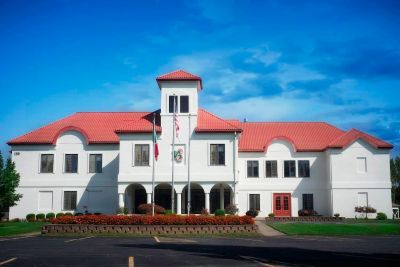
    Italian-American-Community-Center-of-Rochester---IACC-Building-Pic.JPG

    “Everyone is Italian who walks through this door,” says IACC Office Manager Cassandra Pettrone.


    If you enjoyed this article, consider subscribing to my newsletter for more content and updates!

  • How the Italian-American Cultural Center of Iowa Keeps Heritage Alive

    How the Italian-American Cultural Center of Iowa Keeps Heritage Alive

    Beginning in the late 19th and early 20th centuries, Italian immigrants with farming backgrounds began arriving in Iowa. However, most came without the money to purchase the necessary land. Instead, they found work in the coal mines of southern and central Iowa, or settled in areas such as Oelwein, Council Bluffs, and Des Moines, where they laid track for the state’s railroads or worked on streetcars. After the mines closed, many workers moved to Des Moines and formed their own Little Italy.

    In 1981, a small group of proud Italian immigrants founded the Italian-American Cultural Center of Iowa to build on the legacy of those original settlers. The 501(c) (3) organization aims to promote, preserve, and share Italian heritage and culture with the Des Moines metro area and the state of Iowa through a museum, events, and on-site amenities. Even this year, amid renovation and remodeling, the center remains a hub for everything from bocce and Italian language and genealogy classes to a St. Joseph’s celebration and gala.


    I spoke with Therese Riordan, the Italian-American Cultural Center of Iowa’s Secretary of the Board of Governors and Chairperson of the Heritage Advisory Council, whose parents were among the founders. She’s been with the organization for more than three decades, honoring her family’s largely Calabrian heritage. Her mother, Patricia Civitate, the Center’s former Director, remains an active member at 95.


    Therese shared more about Des Moines’ Italian ties and the organization’s offerings, challenges, and goals.


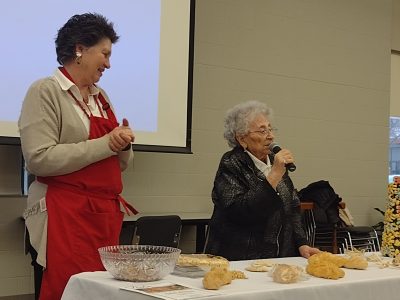
    Patricia Civitate speaks to a women’s group about the significance of the St. Joseph’s Altar and breads.

    What most memorable events or initiatives has the Center hosted over the decades?

    We hosted RAGBRAI from Veneto when they came over from Italy to ride on the Iowa bike tour. The Center also hosted receptions for visiting Italian sports teams and sometimes gave tours of the city. We also provided meals for people who toured our museum.


    Our organization pursued a partnership between the Greater Des Moines Sister Cities and Provinci di Catanzaro in Southern Italy. We’ve hosted Italian chefs from various regions on three occasions. Folk dancers affiliated with us (although it’s a separate organization) have hosted the Italian Folk Art Federation of America Conference in Des Moines twice. And we’ve sponsored numerous trips to tour Italy.


    At our museum, we’ve had some nice, one-of-a-kind things come in. We have a large display of regional hats donated by a lady in New York. We also received puppets. Someone recently donated a hand-carved Italian Jesus made from Italian wood, and a story goes with that. Somebody even gave us a grand piano, and for me, that was exciting.


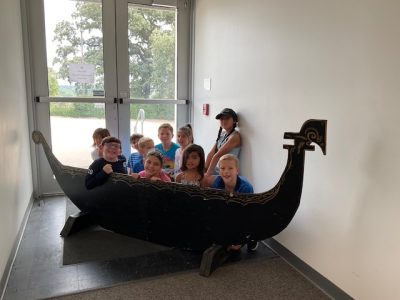
    Day camp members learn about Venice.

    Tell us about your children’s day camp.

    Children from ages six to 12 are invited to spend the week with us, and it’s a themed week. This past year, we set an Italian table. They made a centerpiece and an appetizer, and they learned the Italian language around those things, watched videos, sang songs, and did some crafts.


    Every day, they do a craft, learn the Italian language, cook, make music, and play a game. They have five days to put together an Italian meal, which they can take home.

    We’ve done some fun stuff. I don’t think we’ll do volcanoes again. That year, we had 21 kids, which is an unusually large number. They made their own volcanoes after we studied the Italian volcanoes. We let them have them erupt, and it was very exciting, but it was very messy. That was a good time.


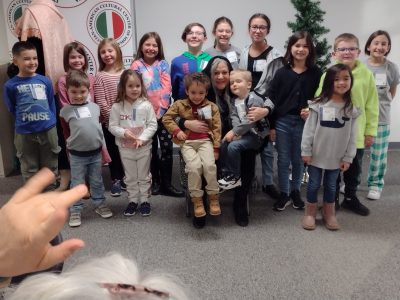
    The children meet La Befana, Italy’s beloved Epiphany witch.


    Tell us about your other offerings.

    The Iowa Genealogical Society of Iowa has generously allowed us space for our language classes. They have been approximately twice a year for the last three or four years. They have been fairly well attended, and people on their way to Italy are always anxious to take them. We’re hoping to continue doing those.


    We offer translation services for people who need them and have provided dual citizenship classes. We also have a lady who’s extremely good with genealogy, so she’s very welcoming and helpful whenever there’s a question. 


    We hosted our St. Joseph altar celebration and Italian Father’s Day in March, an activity we haven’t been able to do recently because of COVID. It involves putting together a large center altar and then six or more side altars, and they all have to be decorated and laid out with memorabilia from the organization that sponsors it, plus fruits and vegetables. It used to be with a dinner, but we couldn’t do that this year. But they did a beautiful job of decorating.


    Members prepared veggie frittatas to donate to the Catholic Worker House as part of their annual St. Joseph Altar celebration.


    Are there any upcoming events you’re particularly excited about?

    We will have our October heritage month—whatever we can do without being in the building. We will have a large fundraising dinner in November, which should be extremely nice. We haven’t done this for a few years, but there’s a new committee working on it, and it should be beautiful. It will feature a chef from Italy.


    What are your challenges and goals?

    The challenge in the capital campaign is always money. And everybody wants the same pot of money, so that’s one of the things we’re working for. Our plan is not just to be a place for Italians. Our plan is to be a place where we can share what being Italian means with everybody else. It’s not a clubhouse. It’s a place to learn about our background, our customs, and how they fit into the fabric of the United States and Iowa.


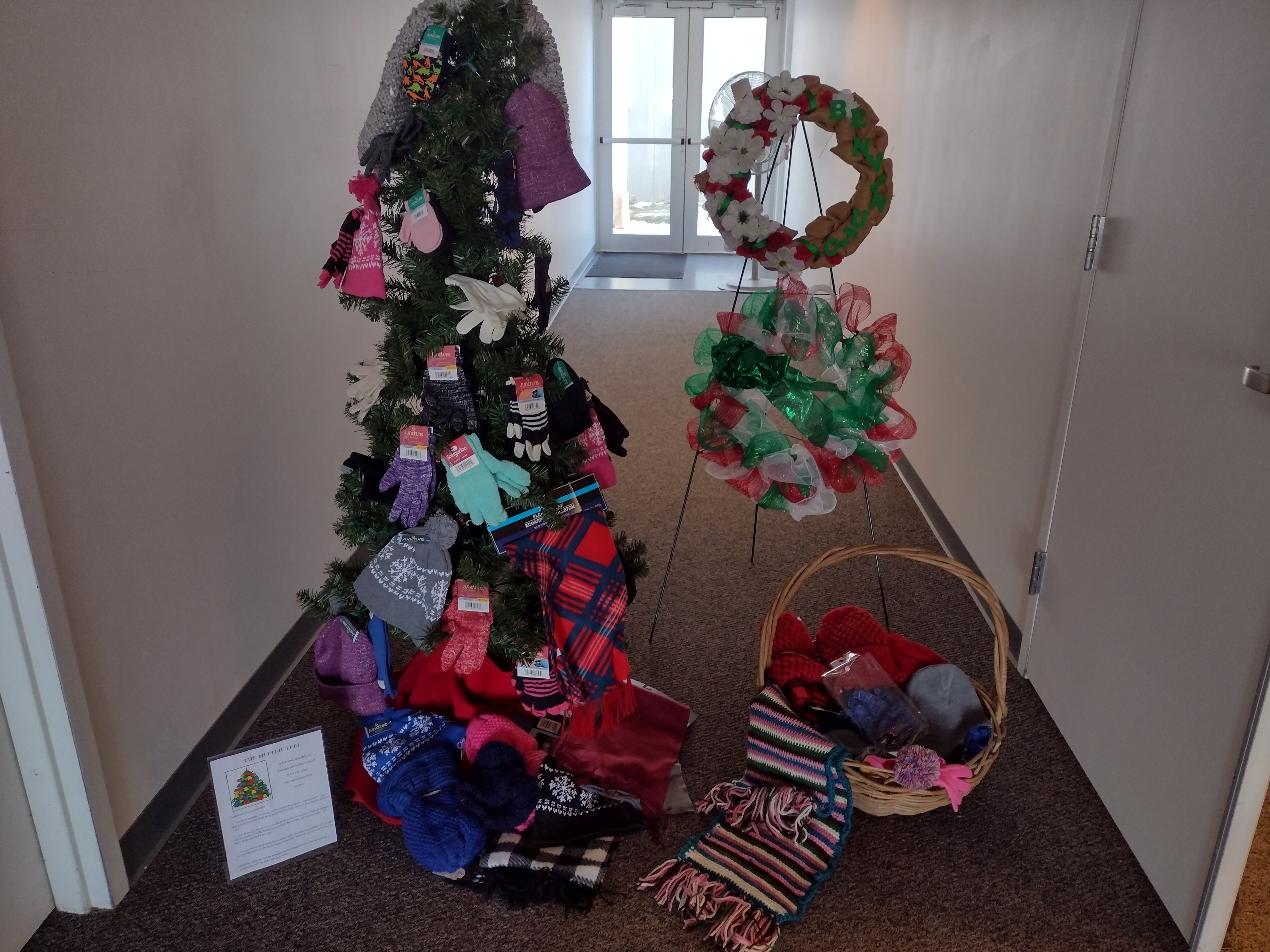
    The Italian American Cultural Center of Iowa’s mitten tree, a collection of donated hats, scarves, and mittens, is distributed to neighborhood centers.

    What do you hope to share?

    We hope that we’ll be a place where people can come and share their stories and learn about Italy, the background of some of the people who came here, and their contributions to the state of Iowa and the United States. Unfortunately, one of the things that, if you say Italian, is the first thing people think of is the mafia. There is so much more than that. There are so many contributions that Italians have made to the world and the state of Iowa that we would like to highlight, and we’d like to give this an opening for people to come in and talk about themselves and their backgrounds.

  • How the Holy Cross Society Celebrates Sicilian Heritage Through Food, Music, and Community

    How the Holy Cross Society Celebrates Sicilian Heritage Through Food, Music, and Community

    Boasting one of the most authentic Sicilian food festivals in the region of Pennsylvania’s Lehigh Valley and Western New Jersey, Holy Cross Society members are proud to pass on the traditions of their ancestors, who migrated from Santo Stefano di Camastra in the Province of Messina. The organization has evolved since its 1911 founding while staying true to its deep Sicilian roots. Each September, they host their annual Holy Cross Celebration & Sicilian Food Festival, which began as a reenactment of Santo Stefano di Camastra’s own La Festa del Letto Santo in which classic Sicilian foods are served, a queen is crowned, and music and fellowship are shared.


    I spoke with Jim Palmeri, a member of Holy Cross Society’s Board of Trustees and webmaster of holycrosssociety.com, whose grandparents were founding members, about the organization’s history, how it promotes Sicilian heritage, the challenges it faces, and its goals as members embrace the future.


    What is the history of the Holy Cross Society?

    It started with my grandparents and that generation, who came from the same town in Sicily, Santo Stefano di Camastra. Like many organizations at that time, it was what we call today a mutual aid society, providing assistance with reading and writing English, immigration law, financial assistance, and job placement.


    We are into the third and fourth generations of people from that same town in Easton, Pennsylvania, with about 65 families still with connections to the homeland. 


    Holy-Cross-Society-queen.jpg

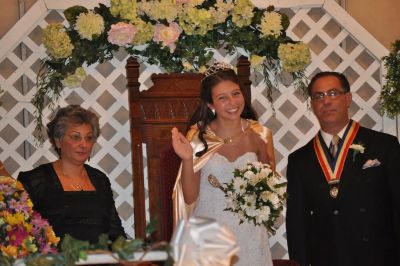
    2011 Queen Gina Palmeri holds court between former Auxiliary President Sandy Callery and former President Tony Tumminello.

    How does the society continue to promote Sicilian heritage in the community?

    We have a meeting once a month. There’s a Men’s Society and a Ladies Auxiliary. Every September, we hold a festival at the same time as one held in our town in Sicily at the church called Letto Santo. About 114 years ago, our grandparents reenacted the same celebration here as their relatives did in Sicily. We focus much of our work around that festival because it’s a bit of a homecoming time. 


    So families come back to town. Usually, there are two days of festival time, Friday and Saturday. Then, on Sunday, we have a Mass of the Holy Cross at our local Catholic church, where we all process in. The priest talks about the Holy Cross. (It’s the Feast of the Holy Cross on the second Sunday of September.)


    We also crown the queen. Usually, she’s the granddaughter or daughter of one of our members. And she has a court. She has to write an essay about why she should be part of the celebration. We’re promoting our Sicilian heritage to the next generation.


    Much of the learning is stories we tell about our parents or grandparents; many of us travel back and forth to our Sicilian town and still have cousins there. So we talk with them about what they’re doing and what’s going on in that town, and share what’s happening in this town.


    Every year, one of our members, Sal Panto, who is also the mayor of Easton, does a trip there and invites people to go. He has opened it up to the public to get enough for a group, but there are always several members of our society. It’s really kind of a cultural exchange and immersion.


    Those trips started on the hundredth anniversary of the Holy Cross Society when we did a bit of a pilgrimage. Maybe 30 of us went to Santo Stefano and spent almost a week connecting with our relatives. It was a really good way to reinvigorate the relationships. Then, a group from Santo Stefano came to Easton to celebrate our hundredth. We went over in the summer, and they came over in September.


    Tell us about your members.

    Right now, we’ll get 35 to 40 members to attend a monthly meeting of the 80 members, which is pretty good. Our charter is closed. You must be a relative of someone from Santo Stefano or married to someone from Santo Stefano.


    Holy-Cross-Society-procession.jpg

    Holy Cross Society members march together in procession.

    What are the highlights of your annual celebration?

    Years and years ago, the organization used to actually march through the streets of Easton, and people would come out and donate money, and they would go from house to house when many of the Italian people lived in the inner city. Now, with suburbia, that doesn’t happen so much anymore. So we still do a procession, but we do it around our chapel grounds just outside of the city instead of through the city streets. It’s kind of a neat thing. 


    The Lehigh Valley Italian American Band comes back every year on Saturday night, and they play. There was a song called “#9” that was composed by the leader of what was the predecessor of the Italian American band led by a guy named Charlie Perello. That song has persevered so much that we still play it today at our festival. When it goes on, people start to clap and sort of sway along with the song, and they know it. It’s almost like the Notre Dame fight song; it’s recognizable. But that’s part of the tradition of the festival. It’s part of connecting our roots. 


    Holy-Cross-Society-band-performing.jpg

    Lehigh Valley Italian American Band performs for Holy Cross Celebration attendees.


    How are you reaching the next generation?

    Every organization—whether it be our organization, Rotary, or Kiwanis clubs—is wondering what will happen with the next generation. And we have been extremely fortunate. Our children, who are now in their thirties, forties, and fifties, are getting involved. Their kids are now in the queen’s court and learning about their heritage.


    We give out higher educational grants to children who are from our lineage. And if we have money left over from that fund, we then extend it to students who are attending Catholic schools. 


    One of our members, our former president, Nick Alfero, is very big on making certain that it’s fun for the kids to be there, so they understand that it is not just a carnival. That’s part of their heritage. And we serve all kinds of Sicilian food. We still have the tripe; we still serve the octopus salad.  


    In addition, we have Christmas parties for the kids now. We’ll do an Easter egg hunt, and for the first time, we’re going to have a picnic just for the families. During the celebration, we’re all working. So it’s part of a homecoming, and we interact with people from the public, but now we’re going to have a picnic just for us.


    What do you hope to share with your members and community?

    I think we share with the members that people came here as immigrants for a better life, hoping that most of them are living a better life (which I believe those who belong really kind of do), and reminding them of the hardships that their grandparents experienced to come to America and why they came to America.


    My grandparents came over pre-World War I. And Sicily wasn’t a great place to live then. My cousin, Pippo Torcivia, lives in Santo Stefano. He’s a very successful ceramic artist. The town is known for its ceramics. So if you go there, there’s a bunch of ceramic factories. 


    Pippo and I are second cousins because his mother, my grandmother, and their brother, Uncle Santo, were siblings. Our great uncle and my grandmother came to America. Pippo’s grandmother was left in Sicily because she was married. The other two were still single when they came here.


    One night, when we were talking, Pippo told me that my Uncle Santo would come back to Sicily. He was a bachelor. He worked on the railroads. So, he did well for himself. And he didn’t have a family. He would go back and forth and buy people shoes. He would give his sister money to live on.


    As Pippo is telling me this story, he’s crying. He pulled me aside and very seriously said, “Can I ask you where Uncle Santo was buried?” I said, “Yeah, I know what the cemetery is.”


    He says, “Would you take me there?” And I said, “Sure.” And on the way, he turned to me and said, “Can we buy flowers somewhere?” So, I took him to a greenhouse that was not far from the cemetery. 


    I took him to the cemetery and showed him the grave. He went with these flowers, sat there, and sobbed like a baby.


    To me, that brought it all together, how we’re two cultures that are really bound. So you have to tell those stories to the kids about where they came from. And we have some pretty darn good young adults who are coming in and joining the organization.  


    If you enjoyed this article, consider subscribing to my newsletter for more content and updates!

  • How Convivio Is Giving San Diego’s Italian Past a Home for the Future

    How Convivio Is Giving San Diego’s Italian Past a Home for the Future

    With 19th-century roots as a fishing village of immigrants from Genoa and Sicily, San Diego’s Little Italy came into its own in the 1920s as a vibrant neighborhood and tuna capital of America.


    Fishing was plentiful, but so were opportunities for seafood processing and marketing. Other Italians chose to open restaurants where they served the fish that locals caught.


    But World War II brought change.


    Italian residents without U.S. citizenship were labeled “enemy aliens.” And in San Diego, fishermen (like their peers on the East Coast) were restricted from their livelihood. In some cases, boats were requisitioned for military use.


    The city’s tuna clipper fleet would shrink nearly 30% by 1959, and when Interstate 5 opened, it sliced through Little Italy. But while families were displaced, many held onto their businesses and places of worship, like Our Lady of Rosary Church.


    Today, Little Italy stands as downtown San Diego’s oldest continuous neighborhood business district, supported by civic and heritage organizations, including Convivio, founded in 2003.


    Executive Director Tom Cesarini grew up immersed in Italian culture and language, with parents who emigrated to the United States from Aspra, Sicily, in the 1960s. He launched Convivio with a focus on preserving and promoting his heritage and its contributions to San Diego.


    We discussed the factors that informed that decision, the key challenges he and his team have faced, the most impactful programs they have developed, and their plans for the future, including the establishment of a new Italian-American cultural center and museum.


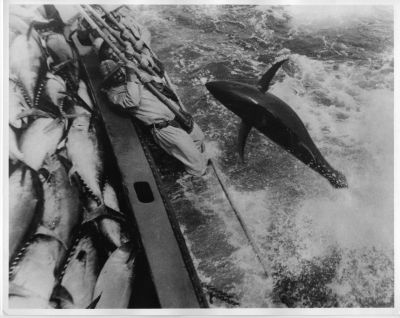
    Men stand in the racks along the edge of the boat, three-pole fishing for tuna in rough seas.  The larger tuna often ranged between 100 and 200 pounds, requiring two to three men to pull the fish on board. (Courtesy of the Portuguese Historical Center)

    What led you to launch Convivio?

    Our Little Italy in San Diego was getting redeveloped at the time, after having almost disappeared altogether through the 1980s. The Merchant Association brought that back, but culture and history were disappearing rapidly.


    I had volunteered in San Diego for several arts and cultural groups, all promoting Italian culture. But there was a lot of infighting. And so as a volunteer, I was left in the cold, wondering, “What just happened?”


    I decided to give it a go myself. I had enough knowledge as a volunteer and was self-educated on nonprofits in general, but I looked at the gaps in knowledge that I had to fill to do it properly. I applied to a nonprofit leadership program at the University of San Diego, got accepted, and that opened up the doors.


    Between 2003, when I founded Convivio, and 2005, when I started the program, I was just putting it together—events and programs—and looking for support slowly but surely.


    Two years of the Master’s program really helped a lot, and for 22 years, we’ve done a lot. We have a great track record. I’m really proud of it.


    We have a good volunteer team, and it’s still growing. We’re always trying to get to the next level in the nonprofit world.  

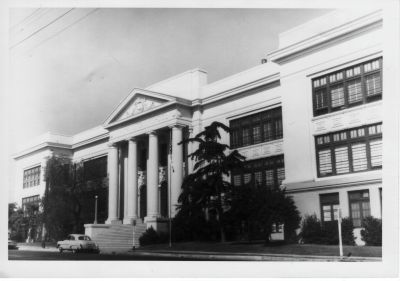
    Washington Elementary School was architecturally modeled after the White House. When this photograph was taken in 1940, the interior was made predominantly of marble, and lion heads originally marked the front entrance but were later removed. The school served the entire Italian community. Sadly, the original building was torn down in 1980. The school, however, was rebuilt for another generation of young San Diegans. (Courtesy of Fran Marline Stephenson)

    Describe Convivio’s focus.

    One of our core components is our heritage preservation program. We establish digital archives to save those stories through photographs and oral histories. It’s one of the things we do, but it’s a very important one.


    We do a lot. There’s something for everybody. Films, author presentations, a book club, a film club, concerts, Italian classes… You name it, we are open to it. The goal is to provide a space for people just to come together, congregate, and build relationships.


    Why is creating a community space so important?

    Other ethnic communities have cultural centers and shared spaces. We had Little Italy, we had the neighborhood, and we had the church that served as an anchor for a hundred years. But I wanted to do something a little bit different, expand our vision for the community.


    I asked people, “What are your ambitions as an Italian-American, as a leader, as a community member? What are your aspirations? What are you looking for?” And across the board, they all said the same thing: we need a home.


    It aligned with what I already knew, but I needed that data. It’s not just me saying it, it’s the entire community saying it, and this is what we have to try to deliver. So we try to fill in those gaps in programming.


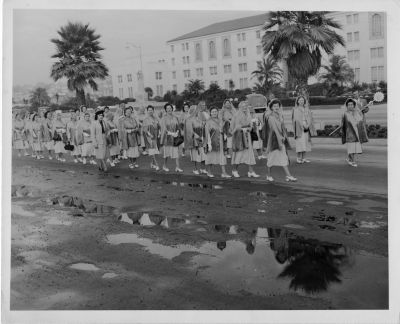
    Processions were of vital importance to the parishioners, and remain so to this day. In this image, circa 1945, the San Diego County Administration building is prominent in the background. The procession is heading toward the wharf, as was customary, culminating in the return to the church. (Courtesy of Our Lady of the Rosary Parish)

    How does collaboration play a role?

    We’re all about collaboration. Who can we work with? How do we leverage each other’s strengths, and how do we better our community and work more efficiently?


    Instead of saying all the time, “I’m Sicilian” or “I’m Tuscan,” let’s also unite and not be so competitive. We saw many San Diego clubs competing for resources. I said, “We’re not going to get anywhere this way. We’ve got to really focus our efforts on coming together.”


    We’ve partnered with San Diego Opera, San Diego Symphony, and non-Italian arts and cultural groups. With those, it’s about “How do we leverage their power? How can they best work with us to benefit both us and them?”


    That component of what’s in it for us often has a negative connotation, but it’s important. We have to look at ourselves if we want to keep going. It’s almost like that self-care notion of if you don’t take care of yourself, you can’t take care of anybody else.


    So, how does it benefit both our organizations? If we can look at that and come up with something, it’s win-win literally for both parties involved in the project.


    What have been your challenges to date?

    The biggest lament is funding for all nonprofits, especially in the arts. We’re constantly struggling to deal with either budget cuts or grant cuts.

    We have private donors who support us. On the grant side, we have fee-for-service programs to raise money. We have retail that we try to raise funds for, so we’re always exploring new funding streams.


    As far as heritage goes, a big challenge has been overcoming stigmas with the community, and overcoming the fact that Italians can be very private. For example, we published a couple of books.


    There were pictorial history books on the community. One was on San Diego’s Little Italy, and a couple of years later, we did one on the fishing industry, which was huge in San Diego.


    I was out knocking on doors, trying to collect photographs. That was a challenge. Some people donated photos, but others were concerned about what we would do with their photos.


    We’re trying to educate the community at large about the importance of our organization, mission, and vision. Our vision is to create a museum and a cultural center on a large scale. And so now we’re introducing that in many ways and trying to gather everybody together.


    It’s getting better now. New generations have come into the existing organizations. We’re seeing a lot of partnering with events with different organizations that you wouldn’t have seen before. If the Italian community is going to prosper and move forward, we have to come together eventually.

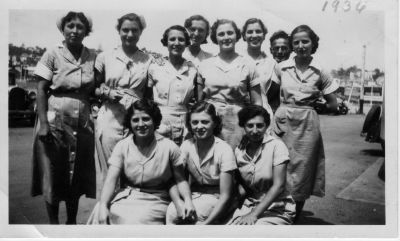
    The fishing canneries employed many of San Diego’s residents, especially women, during the 1920s and 1930s. This group of young women worked for the Westgate Cannery and is pictured outside the company in 1936. Sarah Gangitano Bono is seen kneeling in the front row, on the left; others in the photo are unidentified. (Courtesy of Marie Bono Sohl)


    Which program has had the most significant impact?

    The Heritage Preservation Program. We’ve amassed thousands of images, done oral histories, and now, we’re putting together a repository, moving toward an actual physical museum for San Diego and an arts and cultural center space.


    I think that’s the most important one, because that was severely lacking. We have other groups doing spaghetti dinners and fish fries, and similar events. We do a lot of those things, too. But as far as a more academic bent to organizations, that was lacking. 


    Is there a success story that stands out from your initiatives?

    We had a donor buy property in Little Italy and donate the use of it to us. So we will be establishing a larger cultural center and finally a museum.


    We have a small space we work out of now. It’s a little cottage, a little fishing home that’s been preserved, and it serves its purpose well for us now, but we want to expand and create a larger museum and cultural center.


    We’re in the planning stages right now. So after 22 years of knocking on doors and saying, “This is important,” it’s coming to fruition, and people are starting to buy into it.


    My philosophy is essentially the Lao Tzu mantra: a leader is best when people barely know he exists; the people will say they did it themselves. When all is said and done, the goal is to get the people to do what they need to do. It’s a huge deal for San Diego’s Italian American community.


    AMICIBAR in Little Italy, Convivio’s current space


    What do you ultimately hope to share?

    It goes back to why I started the organization, which was to create and sustain a space where people can come together, put their phones down, sit at a table with strangers, start a conversation, and just learn from each other. That’s what our space is meant to be.


    There’s this notion of a third space or place. The first place is your home. Second place is your work. Where’s your third place? Where do you go for community?

    That’s really what Convivio is about in a nutshell: where you go for community. That’s what we try to cultivate.


    I ultimately hope to share a place where people can do that and learn about Italian culture, but also learn about each other.


    When I chose the name Convivio, I was looking for a name that represented that, and hopefully it does. I can’t find a better one. Uniting and coming together. That’s what I hope to share with purpose. 


    Discover Convivio in person and meet me for this special book event.


    If you enjoyed this article, consider subscribing to my newsletter for more content and updates!

  • Why This Birthday Tells a New Story

    Why This Birthday Tells a New Story


    August 16 marks another trip around the sun.

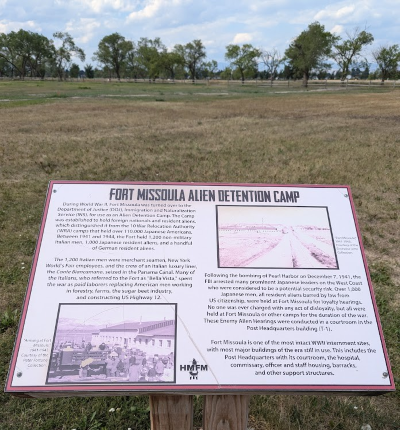
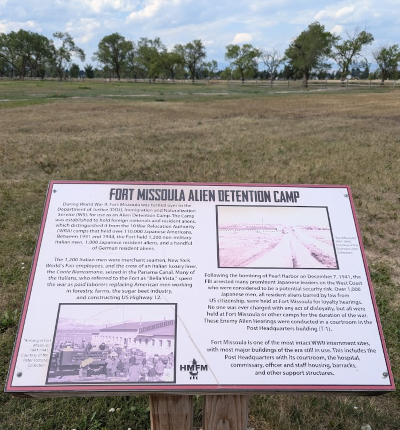
    It has been a year of firsts, unforgettable experiences, and reconnection. My last birthday was spent on a two-week research road trip for Beneath the Sicilian Stars, visiting the WWII internment camp at the Historical Museum at Fort Missoula, paddling Oregon’s Lost Lake, and seeing Glacier National Park’s few remaining ice masses.


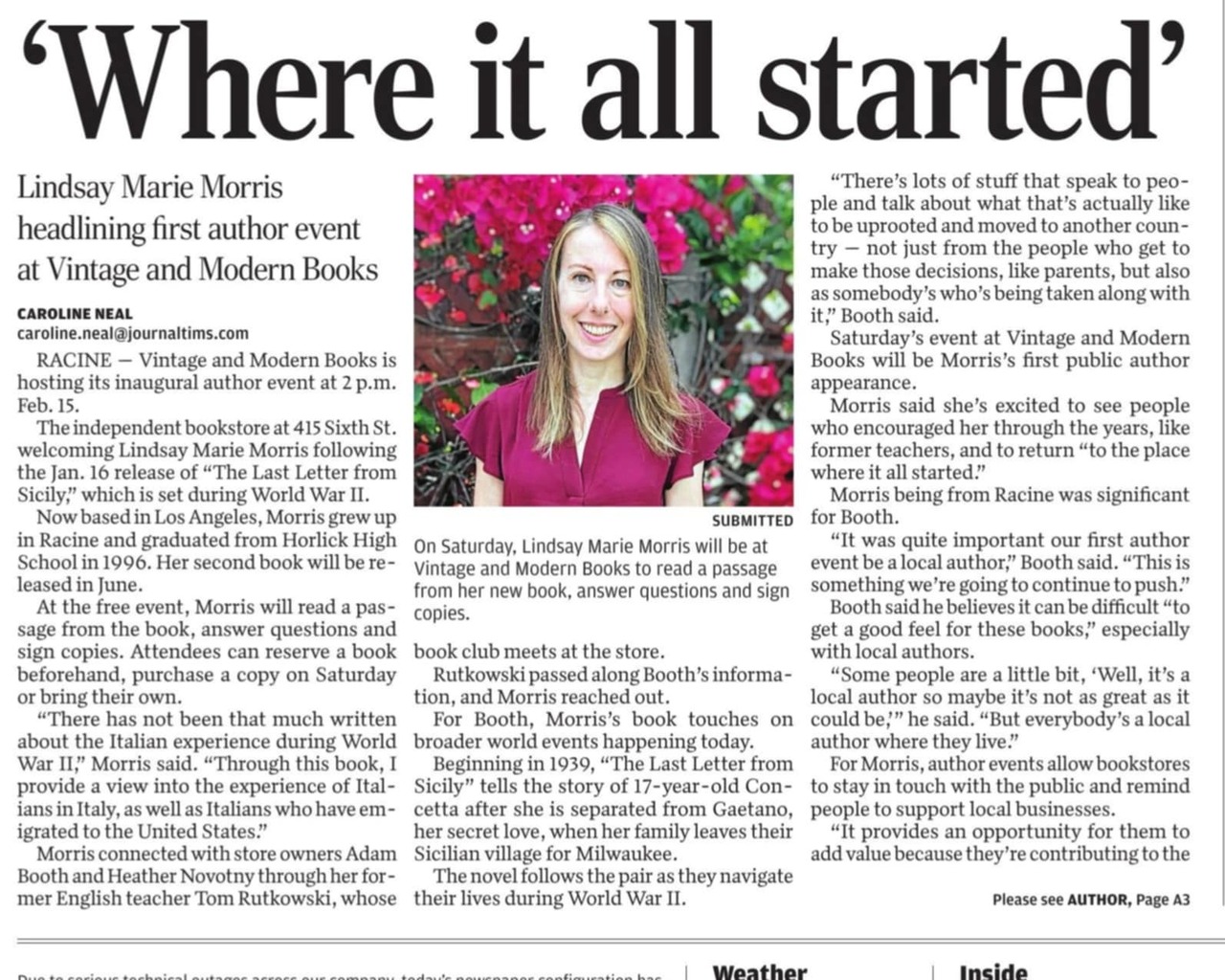
    Four months of nonstop writing followed as I finalized The Last Letter from Sicily. Although my debut was published in January, the hometown launch came in February with a front-page feature in Racine’s Journal Times, bookstore events at Vintage and Modern Books and Boswell Book Company, and reunions with friends and family.

    Journal Times article


    Since then, I have finished a third novel, taught writing workshops, attended the Historical Novel Society North America conference in Las Vegas, and celebrated Beneath the Sicilian Stars’ release with a virtual launch party and a Railroad Book Depot appearance.


    Now, just over a month after my second launch, it is incredible to see reader reviews and hear about the ways people connect with my work.

    What a remarkable trip around the sun it has been. Thank you for your friendship. Here’s to another year of adventure together!

  • From War Rooms to Olive Groves: How a U.S. Intelligence Veteran Found Peace as a ‘Poor Farmer’ in Sicily

    From War Rooms to Olive Groves: How a U.S. Intelligence Veteran Found Peace as a ‘Poor Farmer’ in Sicily

    Anthony Campanella spent four decades serving in some of America’s most vital and sensitive roles, with tenures in the Marine Corps, the Defense Intelligence Agency, and the Department of Homeland Security. His work spanned intelligence analysis, crisis management, and international security cooperation, including deployments to active war zones. Yet no matter how far he traveled, he remained deeply rooted in his Sicilian heritage—something he says shaped his identity and perspective throughout his career. That connection has guided him to a quieter, more grounded chapter: an off-the-grid retirement as a self-described povero contadino (poor farmer) in rural Sicily.

    He recently shared more about his professional and ancestral background, what inspired his move, his challenges, his favorite places in Sicily, and advice for those wishing to settle down on Italy’s largest island.


    Tell us more about your professional background.

    It goes back 40 years after high school. I joined the Marine Corps and was an intelligence specialist, which is a precursor to coming here, because my last two years in the Marine Corps, I spent on a Navy ship in the middle of the Mediterranean. It was summertime—no wars, no conflicts. It was basically a Liberty Cruise, where we just visited 11 countries in the Mediterranean and enjoyed the heck out of it—great weather, great people, beaches, and food. The cost of living was cheap.


    After the Marine Corps, I went back to college, finished my degree, and was hired by the Defense Intelligence Agency in their crisis management shop. We dealt with all current operations around the world, whether it was Haiti, Somalia, Iraq, or wherever there was a hotspot. We were the ones who provided national-level intelligence support to the warfighters.


    I have deployed three times to “active” war zones. The first was for six months in support of Bosnia at the NATO Combined Air Operations Center in Vicenza, Italy. While my colleagues were being sent to places like Tuzla and Sarajevo, I was out of danger and safe and sound in the land of pizza and vino.  


    After that, I was given a Cuba assignment, which didn’t amount to anything, so we never even made it to Cuba. We made it as far as Norfolk, Virginia.


    The third one was in Brazzaville, Congo, because of a coup in Zaire. They thought we might need to evacuate the embassy staff and American citizens. But again, that fizzled out.


    While I was in Brazzaville, I was selected to be the Defense Intelligence Agency (DIA) representative to the White House. So, I spent two years as a staff member of President Clinton’s National Security Council in the White House Situation Room.


    It was a 24-hour operation center monitoring worldwide events. You think you’ll live the glory when you brief the president on a major event, but when something does happen, obviously, it’s in the moment, and you don’t have any answers and get yelled at.


    Really, a great job. It was very exciting. The best two years of my life, I think, professionally.


    After that, I left government service and went into consulting, working for the Joint Chiefs of Staff on September 11 in the Pentagon. When the plane came in, I was the luckiest man in America. I was on the opposite side of the building and didn’t see, hear, feel, smell anything. So I was never, ever in danger. Just happened to be in the wrong place at the wrong time or the right place at the wrong time because I was on the opposite side of the building and had nothing there.


    After that, the Department of Homeland Security was formed in response to the terrorist attacks. I went to work in the intelligence section for General Hughes, who used to be the director of DIA. He became the first assistant secretary for intelligence at DHS.


    I helped them form what became the DHS intelligence apparatus. I did that for a few years, and then I left and went to do foreign military sales and security cooperation with foreign governments on behalf of the U.S. government. I traveled extensively in Europe and Asia to support the U.S. government in providing material solutions to foreign governments.


    It was interesting for a kid from Everett, Massachusetts. I always have to reiterate: Never, at one point in my life, have I ever seen a shot fired in anger. Nor have I ever been in any kind of danger zone. I’ve been extremely lucky to have spent that long of a career in and around international crises, but never once has it touched me.
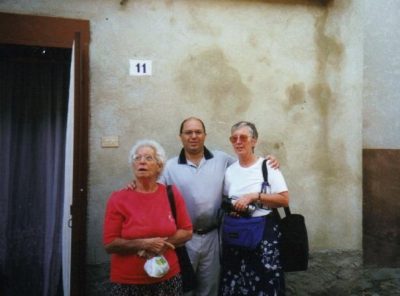
     

     Anthony took his mother and aunt to Pietraperzia for the first time in 1997.

    What is your connection to Sicily?

    All four of my grandparents were born and raised in Sicily. My father’s parents were from Messina, and they immigrated in 1906. My mother’s parents are from Pietraperzia, which is in the dead geographic center of the island. I always say it has more sheep than people. My maternal grandfather came over in 1911, and my grandmother came over in 1913.


    What inspired you to move to Sicily?

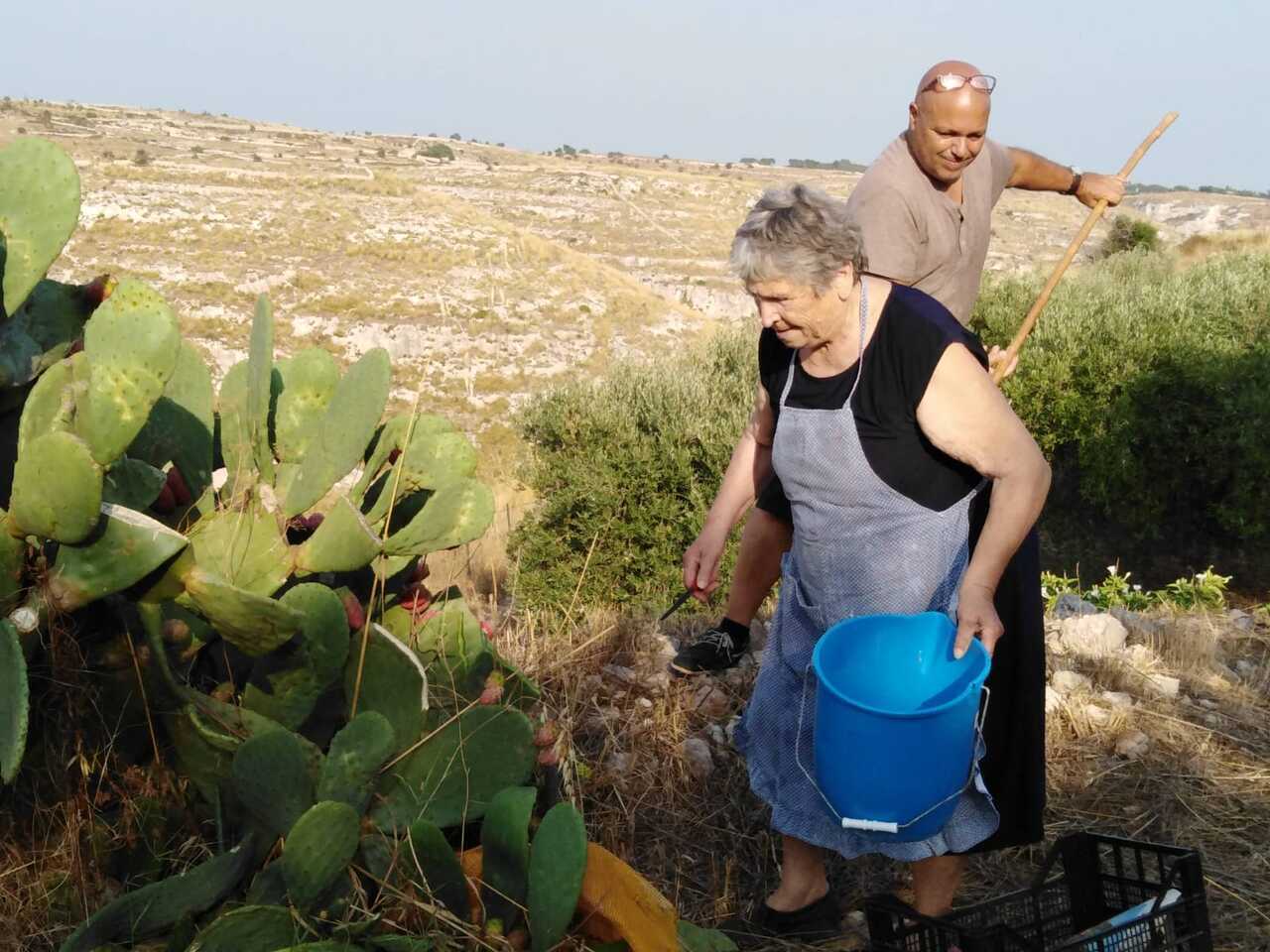
    My grandparents romanticized the island: fig trees on every corner, apricots whenever you want them, and prickly pears by the dozens. This is true, but I also knew there was a reason they left, so I took it with a grain of salt.


    I had never come as a kid or as a young adult. My first time here was in 1988, but it was only a short visit while I was in the Marine Corps. But I had spent a lot of time in the Mediterranean during the summer, so that was when I first started saying, “This is going to be a great place to retire.”


    It’s a great launch point for any other place in Europe or Northern Africa if you want to travel and explore. But it was always kind of a pipe dream. Alfred Zappala of You, Me, and Sicily! used to own a little food store in Lawrence, Massachusetts, called All Things Sicilian. So, after I had gone home for some vacation, my mother and I took a ride up there to check out the shop.


    There was a book, Many Beautiful Things,  written by Vincent Schiavelli, an actor in Ghost, Fast Times at Ridgemont High, and Night Shift. He had made the transition from the States to retiring in Polizzi Generosa. The book was just so captivating, and he made it sound so seamless.


    In hindsight, I probably should have said, “Of course, they all welcomed you, Vincent Schiavelli; you’re a multimillionaire actor.” But that was when I started to put it into motion.


    Why not? I mean, I had basically lived away from my family since 1984. So it wasn’t like I was living with my family on the street and then taking off and replanting myself. I was used to communicating via texts, phone calls, emails, and whatever it was, and seeing them once or twice a year for holidays and summer vacation. So it wasn’t a major transition for me.


    I said, “Now’s the time. You’re not getting any younger; enjoy your life—what’s left of it.”
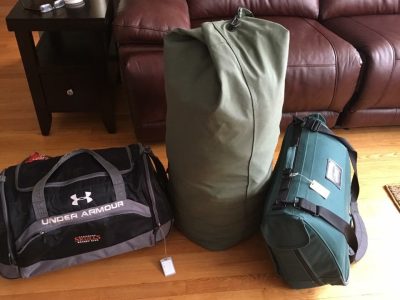
     

    Anthony moved to Sicily with just three bags.


    What challenges did you face settling in Sicily?

    First, I wanted to exercise my right to Italian citizenship, and that’s a nightmare. Even when you follow the rules, it’s a nightmare. Well, I didn’t follow the rules because I had a top-secret security clearance with the government, and I couldn’t apply for a foreign citizenship while the government was entrusting me with their precious secrets. They don’t take it kindly if you’re pledging allegiance to a foreign government when they provide you with this. So I had to wait until I retired.


    I had two options. I could stay in the States for two years and go through the long process of getting my citizenship, but then I would be living in the U.S. with the U.S. cost of living, which would drain resources. Or I could come here and wing it, which is what I did.


    It got done. And I’m legal. Everything’s legal now. I pay my taxes, I do everything. The Carabinieri are not coming to the door.


    The strange thing is that when you apply for citizenship, you do so at the city hall here at the Comune, which is unheard of in the States. You wouldn’t just go to your city hall to apply for citizenship.


    When I applied for citizenship, I went to the Stato Civile and they told me, “We can’t accept your application because you don’t have residency here. You need to go to the Anagrafe and get residency.”


    So I ran over to the Anagrafe and said, “Hey, I bought a house. I live here. I need to get my residency.” They said, “OK, well, where’s your long-term visa?” I was like, “Oh, I don’t have one. I’m here on my tourist passport.”


    They said, “We can’t give you residency. If you only have a tourist passport, you need to go to the Questura in Syracuse and apply for a long-term, elective residency visa. They’ll give you your one-year elective residency visa, Signora Izzo will accept your application, and everybody goes home happy.”


    So I went up to the Questura and told them the story, and they said, “No, no, no, no, you don’t need to do that at all. You go back and tell Signora Izzo to accept your paperwork because she will fill out a form as soon as she accepts it. It comes to us, and we give you your long-term visa because now you’re awaiting adjudication.”


    So, basically, A told me to go to B, B told me to go to C, and C told me to go to A, and nobody was budging. We finally broke the logjam because the guys in the Anagrafe Office did me a solid favor, and I was able to obtain residency without the long-term visa.


    It ended up working out. Two weeks later, I got my citizenship, and everybody went home happy, especially me, and probably Signora Izzo in the Comune, because I think she was sick of seeing my face.


    I moved to Avola, Provincia di Siracusa. I had visited here three times before, in the 1990s, in 2011, and then again in 2015. My requirements were that I wanted to be 10 minutes from the beach and an hour from the airport.


    This zone is beautiful. It’s close enough to Syracuse, close enough to the airport, and right on the beach. So it met, checked off all the checkpoints, and I’m glad to be here.
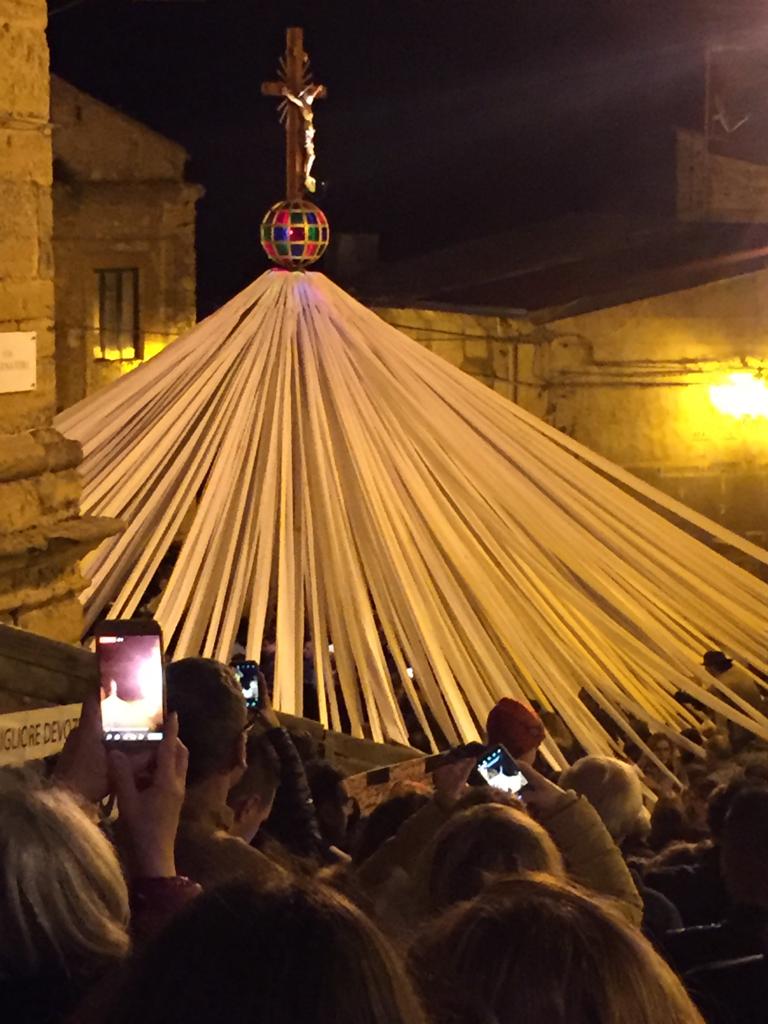
     

    Good Friday in Pietraperzia


    Describe your lifestyle.

    I call myself a povero contadino, a poor farmer in terms of both money and the quality of my stuff.


    A British friend of mine here was renting from this woman who owned this farm up in the mountains. She said, “Hey, you know everybody. Can you come look at this place? She’s trying to sell it. It’s been in her family her whole life. She’s 81 years old, and she can’t care for it anymore. She has three kids and 10 grandkids, and they don’t want it.”


    So I said, “Sure, I’ll come up and look at it.”


    I went up to the mountains and saw the place. There is a house there, but the house is not supposed to be there. So they’ve kind of let it go astray. But it has a beautiful brick oven barbecue area, 120 trees, and about two acres of land where I can plant my fruits and vegetables in the ground.


    I asked my friend, “Well, what is she asking for?” She said, “10,000.” And I bought it right away.


    The owner is now 86 years old, and whenever I collect anything from the trees —whether it’s apricots, pears, peaches, figs, quince, or cherries —I always bring a big cestino, a large basket, to the woman. After all, I figured she’s had this her whole life. She didn’t want to sell it; she was forced because she couldn’t keep up with it.


    So I give her all that stuff, and she’s very, very thankful all the time. But if I plant something in the ground—lettuce, zucchini, eggplant, or tomatoes—and I bring it down to her, she says, “Non voglio,” I don’t want it. And I’m like, “Why don’t you want it?” She says, “Not mine.”


    The trees used to be hers, so she has an affinity for the trees, but if I put something in the ground, she doesn’t want it. She’ll accept the tree stuff because she knows that she’s responsible for those trees being as productive as they are.


    I was not looking for a farm. I was not looking for some land. I had no real desire, certainly no skill.


    I keep learning every day, but I don’t sell anything. I give everything away. I get about 135 liters of olive oil a year and just hand it out. I use that as tips to my barber, butcher, and folks who won’t accept tips. And then I give the rest away to family, friends, and visitors.


    I do the same with all the fruits and vegetables. I just give what I can’t eat to my neighbors here. It’s definitely not a money-making scheme!
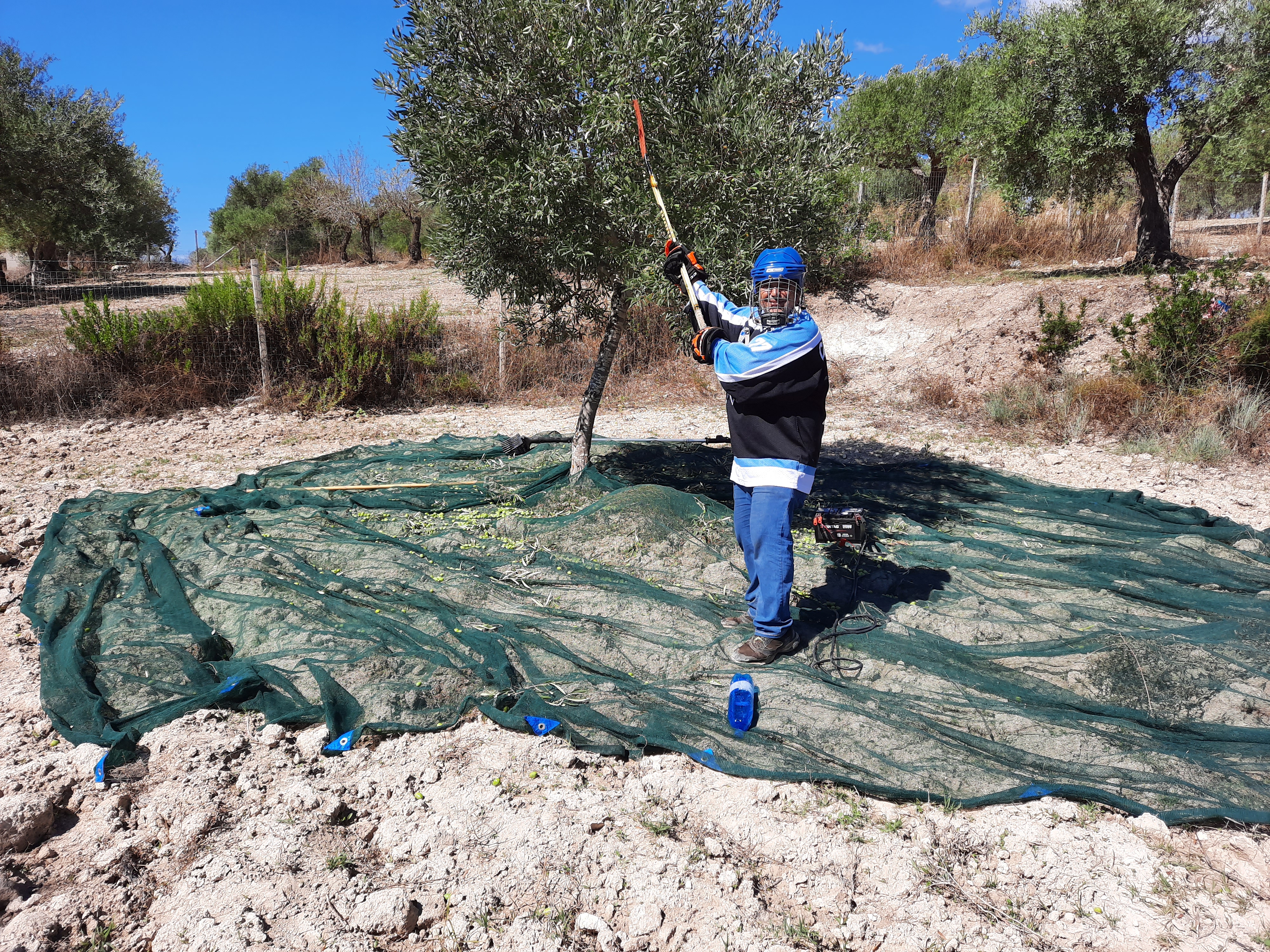
     

    Anthony practices a new farming technique. 

    How did you prepare yourself for this lifestyle?

    I winged it. For somebody who, at work, is very fastidious in planning everything, I figured it out when I got here, and that’s literally what I did.


    I have one cousin who lives in Pietraperzia and speaks English and Sicilian fluently. He’s been a godsend whenever I’ve needed assistance trying to meander through some kind of bureaucracy or vehicle issue or something like that. So he’s been very, very helpful. So I did have a support system here—a support system of one, but that’s really all I needed. And I had traveled to probably 60 or so countries before I moved here, so I think I’m very good at assimilating.


    I wasn’t worried about coming in and not having my Starbucks or my McDonald’s. So that stuff was never a problem. The bureaucracy is the bureaucracy.


    Citizenship was really the hardest thing. I had told people that I think the motto for Italian bureaucrats is, “As long as I’ve done nothing, I’ve done nothing wrong. So you can’t tell me I messed up. I didn’t do anything, so I didn’t do anything wrong.”


    That was my biggest headache, because I’m a get-stuff-done kind of guy. But I just kept telling myself, “Hey, you’re paying a euro a kilo for fruit. Settle down, suck it up, and go with the flow.” Other than that, there were no transition problems whatsoever.


    When I bought this house here, I technically didn’t even know I had bought it. I had come here on a Friday night, and we looked at it with a realtor, and I made my offer. They said, “We have to talk to the owners.” I said, “Sure, no problem.”


    We were leaving town 15 minutes later, and he called and said, “They accepted the offer. Can you come back on Monday to do the paperwork?” I said, “Sure.”


    I thought the paperwork was writing out the formal offer, but they tossed me the keys after I signed. I didn’t even give anybody a penny.


    So, even buying the house was simple. Obviously, no homeowner’s inspection, no insurance. Because two days later, I called my cousin. I was like, “Filippo, we forgot to get insurance.” He said, “What do you need insurance for?” I said, “I bought a house. What if it catches on fire?” He goes, “What’s going to catch on fire?” I said, “Well, if somebody breaks in and steals something?” He goes, “You buy a new TV; what do you care?” I was like, “Well, what if somebody falls down my stairs?” He goes, “They fall down your stairs. Who cares?”


    I’ve lived in this house for more than seven years and have never paid a penny in insurance, which is crazy to me, but that’s the way it is.
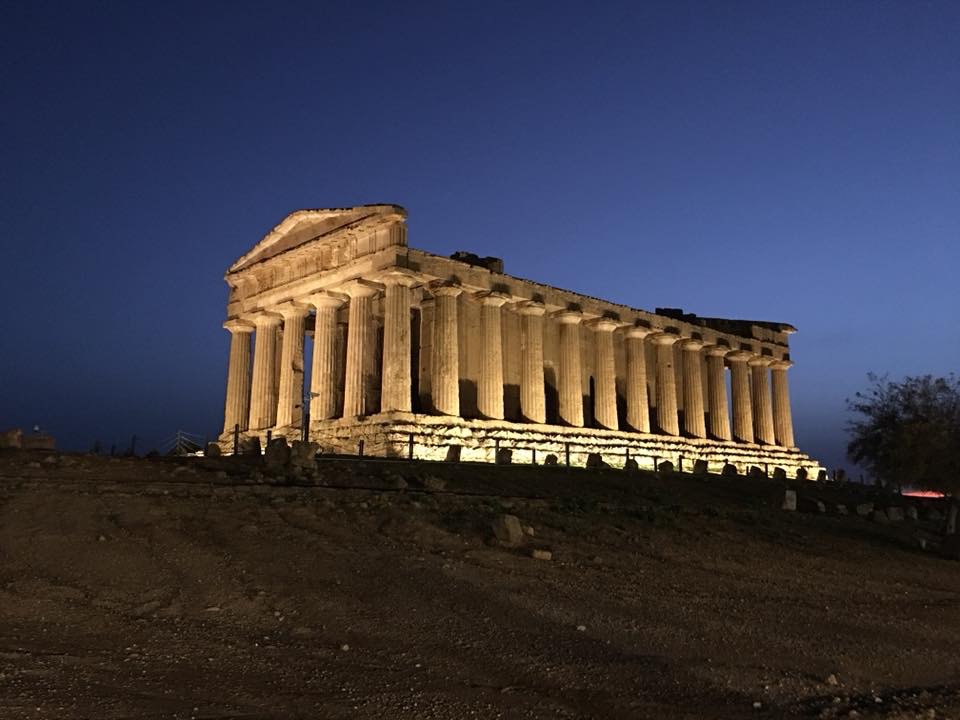


    What are your favorite places in Sicily and why?

    I absolutely love Agrigento’s Valley of the Temples. That’s my favorite tourist spot. Other than that, I just love to go into the center of the country, go to Valguarnera Caropepe, or one of these small towns that have been abandoned by those who have had a mass exodus to the States, because it still has that look, that feel, that flavor of 1947.


    Pietraperzia is a grand example. You go into the piazza in the daytime, and there are 200 men out there playing cards, drinking beers, and yelling at each other. They’re there every single day.


    There are no women; I’m not saying that’s a good thing, but just that mentality that they’re still in 1947. And I’ll often ask my cousin’s wife, “Why are there no women in town?” She goes, “Why would we want to go down there? That’s where all the guys are.” That’s kind of their mentality.


    There’s a peace in that where there’s no hustle and bustle. Being in D.C. for 30 years, that’s a major transition. Obviously, I like Ortygia or Ragusa. I’m not a big fan of Taormina because I always tell people that it’s not really Sicily. I’m not much of a fan of the big, big cities on the island. I just prefer a laid-back vibe.
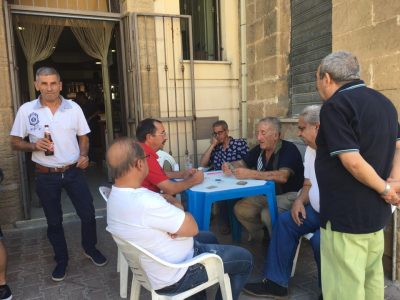
     

    A scene from the Pietraperzia Piazza


    What advice do you have for those considering a move to Sicily?

    First and foremost, be patient. Understand that you’re a guest in this country. Even once you get your citizenship, you’re still a guest here. Understand that, and then just understand the processes and work within those processes.


    I try never to give advice. I tell people what happened to me. I won’t give you advice because the definition of insanity is doing the same thing over and over again and expecting different results. That’s the definition of normalcy here. You and I could do the exact same thing and have different results because you got a different clerk on a different day who is in a different mood. And so you can’t say, “This is what I did, because you said you need these four documents,” because they’ll take those four documents and say, “Nope, you need two other documents.” Or they’ll say, “Why are you bringing me this stuff? I don’t need it. I just need this one piece of paper.”


    For me personally, that’s it. I would just ride the wave. It sounds weird, but what’s going to happen is going to happen to you, and there’s nothing that will prepare you for it. So, just have your Aperol spritz in the afternoon. Have a granita in the morning. If you’re going to sit at the Questura for six hours, sit at the Questura for six hours.


    Other than that, you just have to have the right mindset. You’ve got to be accepting of people and how they operate and work here. You have to have patience.


    Just remember how lucky you are to be here. This is a beautiful, beautiful place.  


    If you enjoyed this article, consider subscribing to my newsletter for more content and updates!
  • Rooted in Tradition, Grown in New Jersey: Angelico Winery

    Rooted in Tradition, Grown in New Jersey: Angelico Winery

    Wine has always been a part of Ottavio Angelico’s life. He grew up amid generations of winemakers in Grammichele within the Province of Catania, Sicily. While he chose to embark on a different path, studying robotics engineering in Canada and finding work in the packaging industry in the United States, those roots drew him back. 


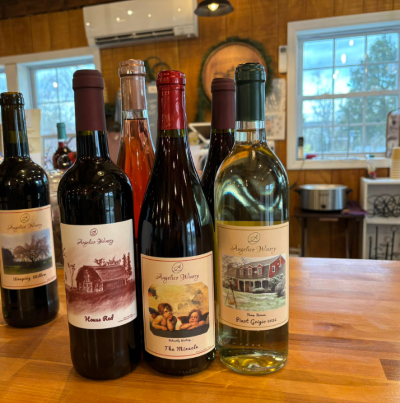
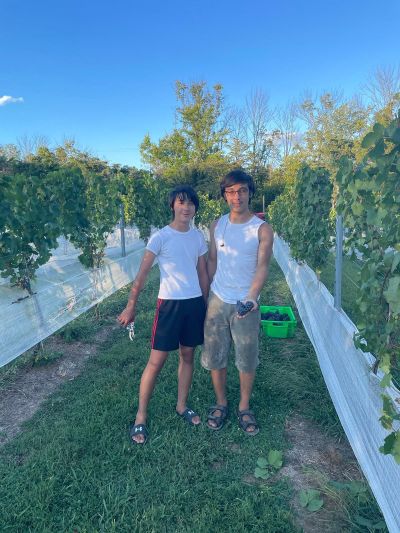
    Three years ago, he and his wife, Lily, opened Angelico Winery in Lambertville, New Jersey, near the banks of the Delaware River. Visitors can pull up a chair at the 50-person tasting room and sip wines from familiar grapes, such as Barbera, Sangiovese, Cabernet Franc, Chardonnay, Pinot Grigio, and Riesling, as well as more unique varieties, like Baco Noir and Traminette. All are picked by hand from the couple’s vineyard. The wines are produced using low-intervention, natural winemaking techniques that embrace the unique microbial environment of the Angelico vineyard, in contrast to the more technical, controlled winemaking approaches common in the United States. 


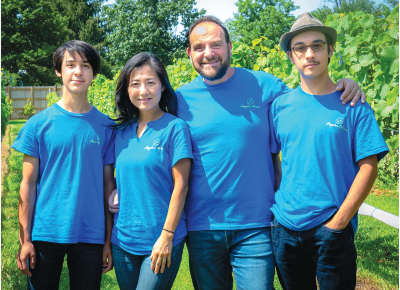
    Lily and the two Angelico sons oversee most operations for the team of 10, while Ottavio continues to work as a full-time packaging manager for L’Oréal. Thus, the winery is truly a family business.  


    Ottavio and I discussed his journey, unique winemaking process, challenges, rewards, and what he hopes to share along the way.


    How did Angelico Winery get its start?

    I’m an engineer in L’Oreal’s packaging department. I would buy grapes from a local supplier and make wine at home. It was, for me, a passion, a hobby, something that expressed my culture.


    I was buying equipment to the point where I had a mini lab in my basement. I read books, and my winemaking improved. One day, I just said to myself, “The wine here, in the United States, honestly is just waking up.” I felt like it was missing somebody who could share some background or maybe share what the culture means for wine.


    So it started from that, and I told my wife one thing we could do: stay working for a corporation for the next 20 years and retire or spend the next 20 years doing it on our own.


    My wife is from China; it’s a different culture, and she was born in the city. She told me, I see that you have the passion you spend every weekend or during your hobby time. She knew what I had in the basement. We had a cellar with over 2,000 bottles of wine, something crazy, all kinds from 2002 when I started until now.


    She said, “This is your passion, so why not work for another winery instead of spending money on a winery?”


    And I said, “Let me try to work for somebody and see if it’s just a temporary fever that I got.”


    So I went to work for a local winery, went straight to the owner, and said, “I’m here just because I want to open my own winery.”


    He told me, “You know what? I see you have a passion. I see you want to open a winery, and I need somebody who works a little bit everywhere.”

    So I ended up working for 11 years, making wine with his staff members. I spent my vacations and my weekends working with them.


    Six years ago, my wife and I said we were ready. We sold our house, and with all our savings from selling the house, we purchased this 10-acre land that we have here today with all the things you see here when you come to visit us: vineyards, the winery, and all the landscaping. And it was done by my family. 


    Angelico-sons-help-Ottavio.JPG

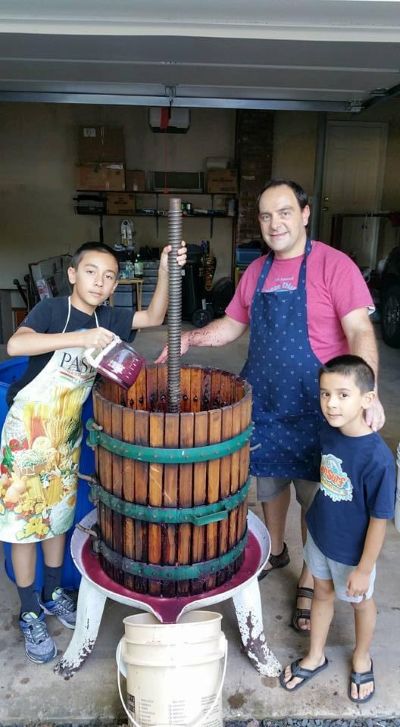
    Sons Antonio and Giulio started helping at a young age. 


    Tell us about your unique winemaking process.

    I started simply with Old-World tradition. I planted Italian grapes. When I purchased the vines, I selected Italian grapes that would adapt here in New Jersey. If they die because they’re not comfortable in the environment, I try to replant different ones.


    Our wines are, firstly, grown with New Jersey soil, on the original vine, so they’re Italian. The second thing is what we call a low-intervention winemaking style. We try not to overkill the wines using sulfites. And my wine does not travel. I am not bringing my wine out of the state. I’m not bringing the wine across the world, so I don’t have any necessity to buffer the wine with any preservative. Years from now, I don’t know where we will be with my winery, but so far, I’m just embracing all the European techniques we used to do.


    I met someone who makes wine here. They have a lot of equipment. They spend a lot of time making impeccable wine, trying to control the process. I agree with that. But if you look at the Europeans, they start from a basic winemaker style. The most important thing is to have the cleanest and healthiest fruit. Yes, we do sanitize. But when we splash the wine on the floor or when we splash the wine on the walls of the winery, we like to have the flavor left there.


    When you ferment the wine from your own grapes, from your own wine in itself, it builds that kind of microbial step with the environment inside. Those microorganisms that might stay around the winery add a unique flavor or identity to our wine. We embrace what we call the natural fermentation of the wine, the natural yeast.


    When you are a local producer, if you’re making 5,000 bottles and you want to represent your local place, you better find out what kind of yeast your grapes catch from the environment where you live and if it is a good one. You want to embrace that yeast. 


    Lily has roots in China. How have your combined cultures influenced the winemaking process and winery experience?

    The culture of wine in China is not as well-known as in Italy, of course. My wife, Lily, has spent the last 20 years learning to enjoy wines, recognizing the quality of the product, and pairing it with food. She offers huge support to the family business today since her culture is really wired for running an effective and profitable business. She is a perfect combination that adds value to our winery.


    She runs marketing and sales. I take care of the quality of the product, bringing my background and experience. She provides unbelievable hospitality and service to our guests, boosting the sales of our products.


    I can make all the great wines in the world, but Lily can connect with people and deliver the product to their minds and hearts. She is an awesome hospitality guru!
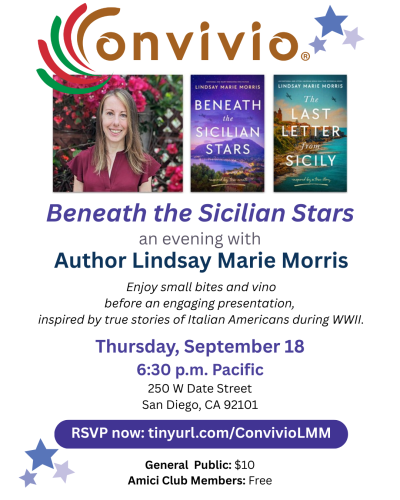
     

    Angelico-wines.png

    Angelico wines: Grown, produced, and bottled in New Jersey.

    What were your biggest challenges along the way?

    The first and possibly the only major challenge is the “People Mindset.” New Jersey has a reputation for having no wine at all or fruit wines. A lot of people need to be educated about what wine truly is, and that’s one core value of our winery.


    Great vines grow in any region of the world, producing unique grapes that represent the territory/area (terroir) where they are grown, so great wines can be produced with such grapes. It will take another five to 10 years to recognize New Jersey as a great AVA (American Viticultural Area) with great wines—a lot of tasting, a marketing campaign, and education. 


    What are your goals for the future of Angelico Winery?

    Based on our core values, we have determined our goals. Our core values are education, quality of the product, and outstanding hospitality for our guests.


    One of our sons is studying and will soon graduate as a winemaker and viticulture expert. He is studying for an associate’s degree at the Finger Lakes Community College and, hopefully, for a bachelor’s Degree at Cornell University next year.


    I’ve personally been taking classes as a winemaker, winery designer, wine connoisseur, etc., at Texas University and UC Davis.


    Our team, led by our tasting room manager and Lily, focuses on wine education for the whole staff so they can relay their knowledge to our guests.


    Lily is continuing to network and take classes/lectures about hospitality.


    We keep investing in more sophisticated equipment, machines, and buildings to improve the quality of our wines and hospitality.


    Overall, we still want to remain a small winery; we prefer small but unique with our own identity. We believe that once a winery becomes big, it starts losing contact with its guests and fails to deliver excellent hospitality.


    Angelico-sons-in-vineyard.jpg

    The Angelico sons have first-hand experience in viticulture.

    What do you hope to share?

    Italians, especially Southern Italians, are all about hospitality and connecting to people. I am already doing it. When people come to see us, it’s more about what we express in our wine, who we are, and how the wine can embrace in that little cup who we are, what I have, and what I’m trying to do here: talking about wine and sharing how it was made and what it’s about.


    This is what I know, and this is what I make for you, and you can be proud of it because I put in part of who I am and part of who you are, because this is coming from your own soil. This is coming from New Jersey; this is coming from the United States.


    I also want to teach people and eliminate skepticism about making wine in New Jersey. I want to tell them that grapes, wines, and human beings adapt wherever they go. For every region in the world, there is always a wine grape that is the most suitable for the soil and microclimate.


    My wife and I are really, really into hospitality. Hospitality is not just a service for us. Hospitality is more about embracing culture between people. That’s what I’m trying to do.


    Everyone who comes to our place does not leave until they have met us and the team. We don’t just shovel a cup of wine and walk away. We don’t want that. We want people to come, experience the place, and experience the wine as a good time, while somebody pays attention to them and educates them, telling them about what we’re trying to do with the wine.


    Wine is more like a chain of connection between our culture and the world and their culture. So that’s what I’m doing. This is not a rich business. It’s more of a passion and labor of love.  


    If you enjoyed this article, consider subscribing to my newsletter for more content and updates!