Freezing temperatures and about a half a foot of snowfall greeted us as we stepped off the plane in Milwaukee. But I’d come prepared in a new coat and pair of boots, having braved many winters in the Dairy State.
I was born in Milwaukee, the place where my grandmother’s family settled after emigrating from Sicily in the late 1930s. She spent the war years separated from the man she loved as he served in the Italian army, and she worked in a garment factory, each enduring their own struggles. They married in Sicily after the war, and he accompanied her back to Milwaukee, where they made a home and raised a family.
Their story inspired The Last Letter from Sicily. So, it was only fitting that my first public appearances for the novel would be in Wisconsin.
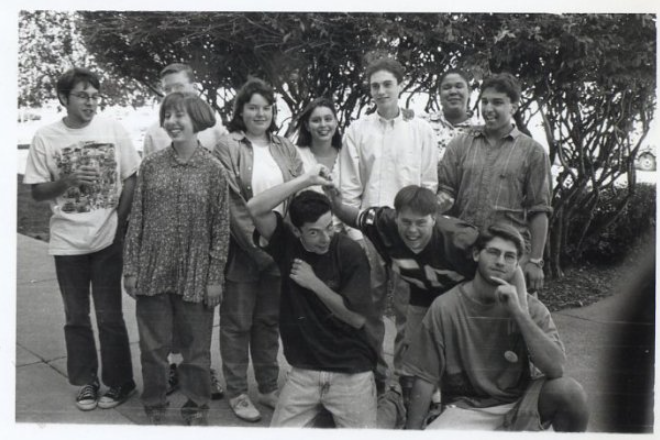
My first event was held at Vintage and Modern Books in Racine, where I was raised and where my author journey truly began. I began writing poetry at an early age, winning an award at 12 for a poem called “Song of the Forest.” I continued writing, and one day, my Horlick High School freshman English teacher, Brian Kelly, recommended I join the Herald newspaper. Writing and reporting on the staff of that paper under the guidance of advisor Dianne Belland ignited a passion for storytelling that would lead me to pursue journalism.
Lindsay (second from left) with the Horlick High School Herald staff
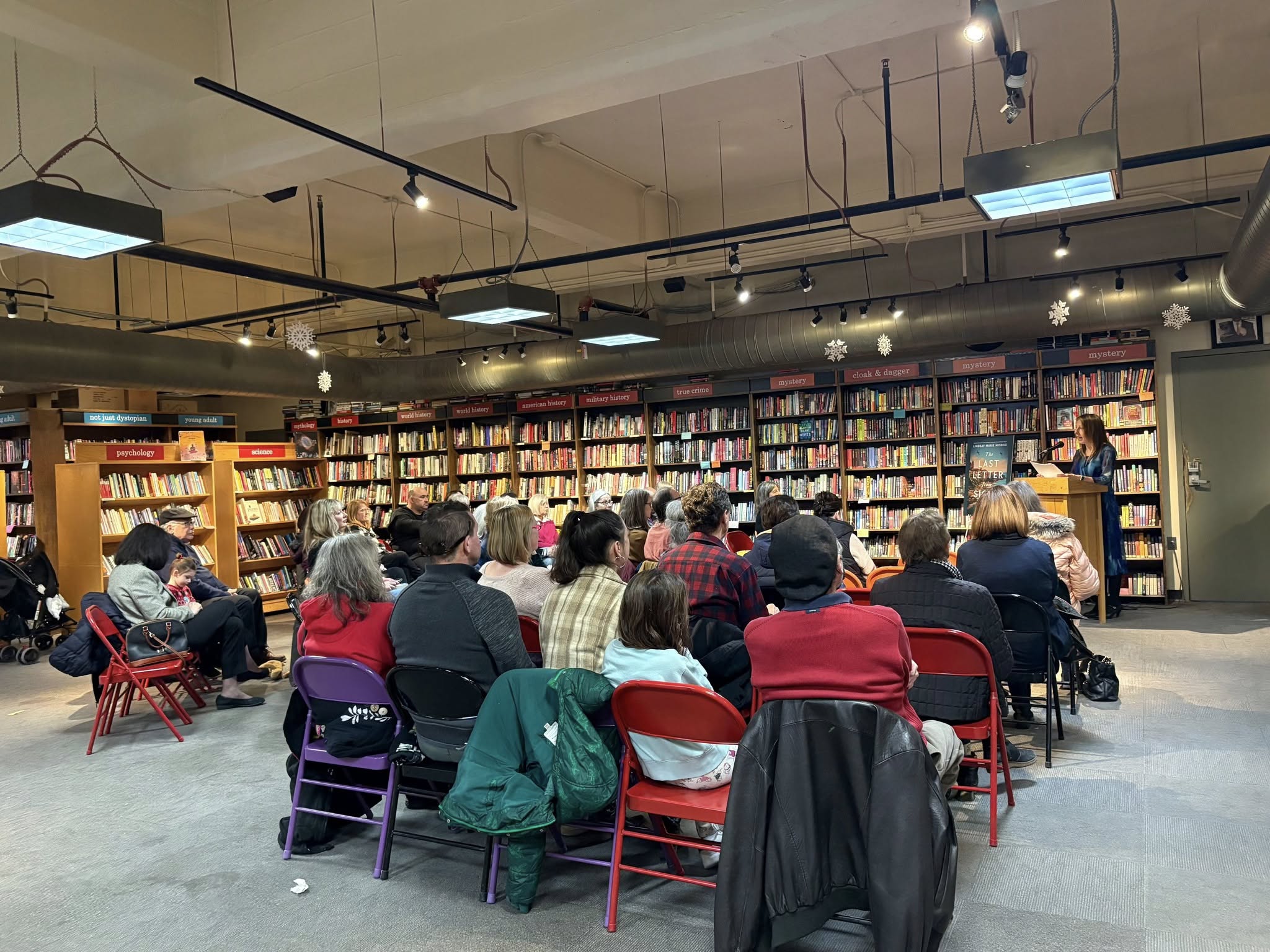
Boswell Book Company hosted my second event in Milwaukee, where I earned my degree in Communications at Marquette University while moonlighting as an editorial assistant at the Milwaukee Journal Sentinel.
Author event at Boswell Book Company
I was grateful to have family and friends in attendance at both events. And it was wonderful to connect with readers. I look forward to sharing more and continuing to honor my grandparents’ legacy.
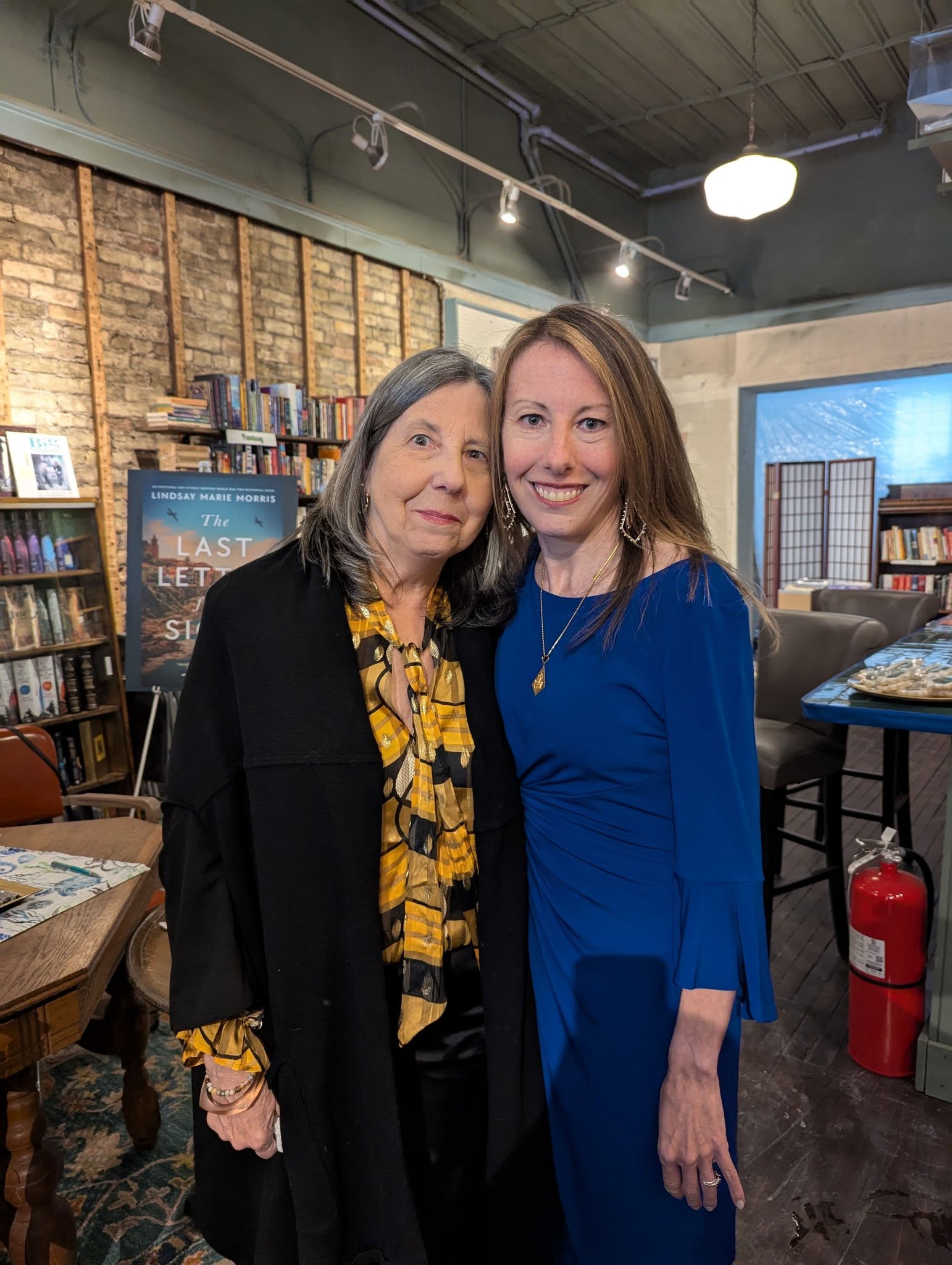
Lindsay with her mother, Santa Maria Morris, at Racine’s Vintage and Modern Books
The saying that one man’s trash is another man’s treasure certainly holds true for New York City artist Daniel Lanzilotta. The self-proclaimed plastician prides himself on his non-extractive practices. He rarely invests in supplies; there’s enough trash paving the streets, floating in the rivers, and washed up on beaches to work with. By fashioning sculptures and jewelry from this debris, he hopes to inspire more conscientious consumption. As a member of Al Gore’s Climate Reality Project and an advisor to The BxArts Factory, Daniel seeks to lead change.
His own inspiration? Daniel points to his Italian heritage and the influence of his family, particularly his grandfather from Barcellona Pozzo di Gotto, Sicily, on his life.
“My grandfather’s there; he’s in me,” Daniel says. “That DNA is very much alive. I carry with me an ancient gene that motivates me and how I see the world.”
Daniel shared more about his grandfather, the type of art he creates, the genesis of his journey, how he selects his materials, the story behind his award-winning The Mask, the unique challenges he faces as an environmental artist, his goals, and more.
Tell us about your grandfather who influenced you.
He was a fancy plasterer. He did a lot of beautiful cornice work, all the stuff you would see in the buildings of probably the early twenties, thirties, and forties. And that wore him out. He then became an insurance salesperson. He was the hero of the family because he did very well.
He was very active in the Democratic party, which I find very interesting because Italians are often not. I used to go with him to give out flyers. I remember it might have been for Hubert Humphrey—that’s how far back.
My grandfather was a hoot. He never owned a car; he would walk and take the bus everywhere.
He would come every Sunday. They didn’t live far away. And he would knock at the door and say, “Guess who?”
He and my grandmother dressed as if they were going to a wedding every single day. I’d say, “Where are you going, Grandpa?” And he’d say, “To get milk,” while wearing a three-piece suit, pocket watch, hat, big overcoat, and beautiful, clean, shiny shoes. This was every single day.
He was a very positive, upbeat figure for me. He married outside of his religion, which was the most amazing thing to me. It was the golden standard of marriage for me. They were just the most perfect married couple on the planet. And for him to do that at that time was gigantic. He was the most courageous person I ever knew.
Describe your art.
I work specifically 100% with trash and plastic debris. And that is coming at me at all times, seven days a week, 24 hours a day. I’m wearing it right now. It’s my clothes, it’s in my body. It’s past the blood-brain barrier. It’s in the food, it’s in Himalayan salt. Microplastics are everywhere.
I gave myself the name plastician to imply that I am working with plastics. I’ve been doing the plastic thing for 28 or 29 years now, and it has been a very long journey of doing this. And through that journey, I became an environmentalist and an activist. My premise is that I tried to bring significance to the seemingly insignificant, meaning that the bottle cap you see on the street as litter is something way more beautiful than that.
I speak about consumer-extended responsibility and not so much producer-extended responsibility like Coca-Cola or Pepsi, who make the most plastic stuff in the world and have complete disregard for what happens to it. I ask, “How did it get there, and whose responsibility is it?”
As the end user, we are all responsible for ensuring it’s put in its proper place because only 9% of plastics get recycled theoretically. So what happens to the other 91%? That goes to landfills, the ocean, and incinerators.
I use beauty through art to capture people’s attention and then have a conversation. I’m not the plastic police. In fact, I just got accepted to New York City’s Sanitation Trash Academy. I signed a paper for training with the New York City Department of Sanitation. I sent it in thinking I wouldn’t hear from them for weeks, and five days later, they said, “You’re in.” And I said, “Yes, I’m the right guy.”
So, it’s about awareness and one’s personal responsibility to deal with the issues at hand. And they’re very detrimental at the moment.
What started your plastician journey?
I was sitting on the beach in France with my son, who was three years old at the time. And he was playing with plastic toys, and I was sitting there looking at plastic debris on the beach. So, I started making assemblies. I was just taking stuff off the beach. I could only use what I found—no screws. I used my Swiss Army knife and started making stuff. I still have all those original pieces, and I would go back by myself and take walks. Then, I kept seeing the same trash over and over and over and over again. And this went on for years, and I just started honing my skills with it.
I am one of the 2024 Human Impacts Institute’s Creative Climate Awards recipients for one of my pieces, The Mask. And I have a piece now in TriBeCa. So this art has taken on a life of its own, and I did not ever realize that I would get to this degree, into this depth of it, 29 years ago.
I’ve been to zillions of conferences about climate change, and they never speak to the art. They’re speaking to business, how to create business from a crisis. I have always found that very interesting because you have to deal with crises and change behavior. That’s what my real platform is now: behavior modification.
Can you elaborate on how your work brings significance to the seemingly insignificant?
I’ve attached this concept to the idea of humans. I deal mostly with plastic debris. In the beginning, it was mostly around ocean debris found on beaches. Then, I made the connection between the single-stream use of plastics and human beings and how human beings are treated in society as single-stream use of human beings.
What does that mean? So you’re walking down the street, and of course, you see plastic bottles, caps, and other plastic debris constantly coming into the environment. It’s mostly, if not all, caused by human beings. It’s either carelessly done with the intention of it being thrown out of a window into the environment or placed in overfilled garbage cans.
When I look at trash in the environment, particularly litter, I see displaced energy. That item took an effort and a certain amount of energy to create. If it’s a candy wrapper, it was made, printed, transported, and traveled to a store. Then, it was used to protect the product and wound up as litter. So that’s displaced energy.
When I look at litter, I’m looking at human trauma: personal trauma. Why would someone do that? How does someone do that? And I equate that with rage, anger, carelessness, and laziness. I see this in many different locales and environments that I go into, and I take trash walks, particularly in New York City and neighborhoods where people don’t really care.
When I was growing up in the Bronx, it was very, very clean. Everyone took pride in sweeping, cleaning, hosing sidewalks, trimming hedges, and shoveling snow.
So, making that connection and bringing significance to the seemingly insignificant is essential. I take out of that bottle cap that was displaced and thrown into the environment as litter and create something of beauty from it. Thousands of handmade beads are in my work. I make sculptures, hats, earrings, and all kinds of really incredibly beautiful things from that trash.
I once worked on a crack vial project. Crack cocaine, if you’re not familiar with that, comes in very tiny plastic, colorful vials. They’re all over the place, so I started collecting them five years ago and made a sculpture. And when I walked into a park up in Harlem, I saw someone keeled over. And I realized that it wasn’t a single-stream use of plastic that I was looking at anymore. It was about single-stream human beings and the same attention to litter—or the lack of attention—that is not given to the situation at hand and its impact on our lives. That person who’s addicted to hardcore drugs and keeled over or literally overdosing is not cared for either. That person became a single-stream human being. They have a story, and drugs started to play a very pivotal role in their lives, where they’re now out on the street. So, I saw the human being becoming that single-stream person who needs to be attended to.
How do you select the plastic debris and other materials you use in your art?
I don’t look for stuff, but it finds me. And the times that I do go out for trash walks, I’m looking at content, I’m looking at how people shop, and I’m looking at what’s getting thrown out.
Most of the time, I am walking. I have two aspects to it. One aspect is that I look for toys, and I have hundreds and hundreds and hundreds of little human figurines, which I really don’t use in the artwork. It’s just a comment on society and what I find in the toy world.
The stuff I use as materials in the artwork is just the constant flow of materials. It’s never-ending. It’s in the streets and the rivers and on the beaches, and it just depends on what catches my eye.
For instance, I made a few pieces from Tropicana orange juice caps, which you constantly see in the environment. On another level, there’s the Tropicana orange juice container. They’re just very interesting and have beautiful designs, so I use them in my work.
Most of the stuff I find speaks to me in shape, color, and form, such as the type of plastic. And I don’t always use it. I hold onto it, and then I make pieces. I use a lot of laundry detergent jugs of different brands. The colors are all very interesting and beautiful.
So the environment is constantly feeding me plastic at some level somehow, somewhere, wherever I go. It doesn’t matter what country or what city. It’s always in the environment when you least expect it. You think you’re in such a clean place, but it’s not. It’s lurking somewhere. Some interesting shapes will pop up.
Urban centers, of course, are the best places to find the treasures. I don’t spend money on art supplies. Over the years, I’ve concluded that what I do is non-extractive, and one of the key points is that I’m taking trash out of the environment. Plastics. And those materials were extractive materials from their inception. Most of today’s plastics are made from crude oil, gas, or coal.
Other artists will use extractive materials like acrylic paints and different art supplies based on fossil fuel consumption. That’s extractive art. And so I created this term for myself: I’m a non-extractive artist; I’m only taking out what’s already there. Because of that, I’ve developed many different methods of doing this and processes to make it all stay together.
Tell us the story behind The Mask.
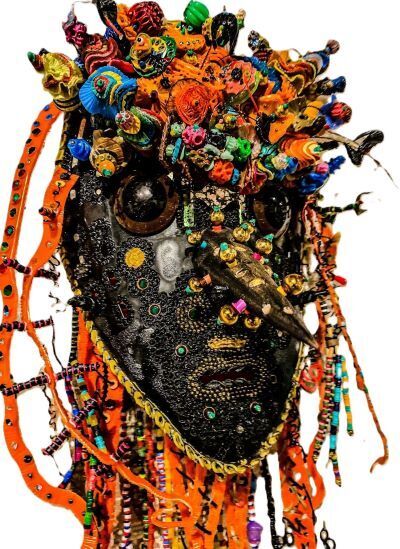
I’m always intrigued by what I find; for instance, the big, black facial part was found on the very eastern part of Canal Street in New York City. And when I found it, it screamed at me. It wanted to be a mask, something I hadn’t made in a very long time.
I was reluctant about it, but it was haunting me. At that time, I was being represented by an art gallery in New York, and the curator said, “Make a mask,” and so I did.
I wound up putting it in the gallery without him knowing. And when he came in, he was just blown away by that.
It’s been a very powerful, powerful mask. It has some kind of energy, and many of these pieces do. I’ve had people stand in front of these pieces and cry. And I was there.
I was blown away by the fact that these plastic pieces touch people in a way that I never expected. One particular piece in particular is Pointing to Heaven, which is about a little girl who was killed. They have an impact that I wasn’t expecting. And the mask is just like that.
It’s one of the winners of the Human Impact Institute’s Creative Climate Awards for 2024. I was very honored to accept that award. It is made of hundreds and hundreds and thousands of handmade beads that dangle to the floor with a filigree or the floral arrangement of plastic on top of the head of the mask.
The process to get there is really a ritual. The piece is more of a totem that addresses the lack of ritual in our society and the process of healing for personal trauma that a lot of us go through but don’t have an outlet to express.
Plastic really is forever. These pieces will outlive many generations, like the ancient arts of the classic periods of Rome, and certainly in the Renaissance, like David and various others, such as Bernini’s doors, which use bronze and marble. These ancient materials have lasted for centuries, but plastics will outdo them by far. We’re talking thousands of years, and under the right conditions, bronze and marble will disintegrate either by age and atmosphere or acid rain. Plastics may break down, but they’re always plastics.
That’s what that piece is really about. It’s a journey. It took many years to gather the parts. I didn’t know it would be the mask, and it all came together.
One day, that mask was fabricated in Bridgeport, Connecticut, and its response has been overwhelming. It’s a mesmerizing piece when you’re present in front of it; it has a haunting benevolence. It’s a cathartic piece again for me, and seeing those who look at it and want to have a conversation about their experience with it has been very rewarding. The face of climate change has been very impactful.
What challenges do you face as an environmental artist?
The pieces that I do stand on their own. But then, when you understand the narrative of the pieces and how they came to be and the story of plastics, fossil fuels, and climate change, you understand that there’s a whole other level of connection. And that art is driving the message about personal responsibility for consumption, the responsibilities of corporations, and how we are going to deal with all this in light of the magnitude of what’s happening. So that’s what an environmental artist is: this converging of activism and a narrative about change. And that’s not easy.
When people see this work, they need to know the story. So the story has to go on the side, on the wall, on a pamphlet, or somehow with the talk. And it has to be verbalized and has to be brought to the attention of the viewer.
It’s not just a pretty thing that looks nice on the wall. There’s a message here to start really reevaluating our participation. We’re all in this together. No one is immune. We’re all consuming and doing stuff that we probably shouldn’t. Some of it is feel-good, and some of it is greenwashing. And so we have to dig a little deeper, make personal changes, and challenge ourselves to start looking at the world because it’s a temporary experience. Other people are coming down the pike, and those folks who aren’t here quite yet have to come to their senses about what we’re leaving behind. And so I asked myself this question: am I finding this place in better condition than when I leave it? Or how will it be when I leave this planet when I die?
My conclusion to my question for myself was, “No, I’m not,” even though I try very hard to ensure I’m doing the best I can. I gave up my car well over a year and a half ago, and now I just go by bus, train, and bike. That was my sacrifice; that was offsetting my carbon footprint. And so I do a lot of that. I don’t own any fancy computers. I don’t have any kind of gigantic electronic equipment. I don’t own a TV. I just have my phone. That’s a challenge.
What are your future goals and projects?
I got accepted to the New York City Trash Academy with the New York City Department of Sanitation, and that’s like a six-week course on everything trash. I am very excited by that, and I hope to gain some really interesting contacts, get involved with the sanitation department, and be able to go and see it. I always fantasize about going back to school and studying trash from an academic point of view.
I would like to get into more galleries as a solo artist. I decided to do a trash chandelier. I’ve had these pieces for a very long time; they’re some kind of plastic armature that I believe thread came on. They’re very colorful and beautiful, so finally, I decided, “I have to use these things.”
I have about 12 of them, and I’m only using two for the chandelier. Everything has to be from the trash, and it’s going to be quite stunning. And I’m very excited by this piece of work that will come of it. It’ll take a year or more at the rate I go. And so that’s very exciting.
What do you hope viewers take away?
It’s about the single-stream use of plastic and bringing significance to the seemingly insignificant, like that bottle cap no one cares about and that person no one cares about. It’s also about bringing consciousness to the plastic issue of litter and creating art from it to have a narrative about creating a dialogue.
When people look at my work, they’re drawn into it by its beauty, texture, and color. A lot is going on in these pieces. And so they’re intrigued by them. I’ve had many occasions where I’ve had the opportunity to speak live in a gallery or at an event where I’m asked to speak specifically about what I do. I bring this to their attention: It behooves us as individuals to take responsibility, deal with our trauma, and deal with our unbridled shopping and consumption.
Among his fondest memories of growing up in Viagrande, Sicily, Carlo Raciti remembers days he stayed home sick from school. He’d step into his family kitchen and roll out fresh pasta or bake cookies to surprise his mother, Caterina Scuderi, when she came home from teaching.
“I was always involved with flour and dough,” Carlo recalls. “That was my passion. That’s what I was supposed to do.”
But his father, Mario Raciti, who had grown up in the bakery business, suggested otherwise.
“He always told me it was too hard,” Carlo says. “He said, ‘Don’t do it. It’s too much sacrifice, and it’s very little gain.’”
So, instead, Carlo pursued a common Sicilian career path: tourism and hospitality. He did just about everything from cooking and the front of the house to hotel management.
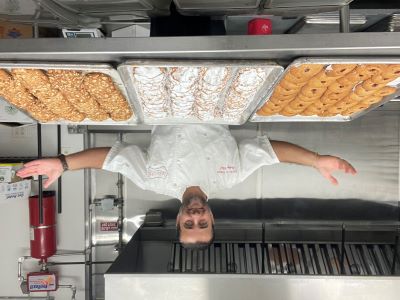
It was overwhelming and led him to drop everything and take a long vacation to Miami. There, he’d meet his wife, Rebecca Bechara, and get an invitation that would eventually lead him back to his childhood passion and opening Almotti, Miami’s first dedicated gluten-free bakery, which sells cookies, pastries, celebratory cakes, and bread with nationwide shipping.
Carlo and I chatted about his influences, career pivot, why he’s embraced gluten-free baking, advice for other entrepreneurs, and more.
How did your family influence your passion for baking and pastry arts?
My grandma started baking bread during the war while my grandpa was stationed in North Africa. She had to feed a big family, so she started baking bread in their backyard in Acireale. They had a brick oven, and that’s how everything started.
They opened a retail bakery, making bread, and all the family baked there. My dad is the smallest of the five kids. He helped a lot and made the bakery deliveries on his bicycle.
After many years, my uncle opened Panificio Raciti in Acireale, which is still there. My cousin now runs it.
During the summertime, when there was no school, there was no one at home to take care of me. So, since I was six, my parents used to drop me off at the Panificio at 6:00 AM. I spent those days sitting in a little chair watching my Zio Tanino with my cousin Marcello and another assistant making the bread. And that’s where my passion really came in: spending that time inside the Panificio. And that’s influenced me 100% for my future and career today.
Mario Raciti (left) grew up making deliveries for his mother’s bakery, a business that inspired Carlo to pursue pastry arts.
How and why did you pivot to becoming a pastry chef?
I was working in hospitality back in Italy when I left my job. I decided to take a vacation with friends, and we ended up in Miami for three months. Then, I met my wife.
I went back to Italy for a year and then returned by myself. During those three months in Miami, I had done a lot of cooking. A friend of mine, through my wife, said, “When you come back, we’ll do a catering company, and you’re going to run it, or you’re going to be the chef.”
So when I came back, we developed the plan and launched a Sicilian-style catering company. That was right before the crash in 2008.
Besides catering, I collaborated with an Italian association called Society Dante Alighieri, which is worldwide. They hired me to teach cooking and baking classes for Italians and Americans. Since they were learning Italian, I taught these baking classes in Italian. In the meantime, I started doing a bunch of catering and events.
My wife and I wanted to start a business—a bakery. That was the idea. So, in 2009, we moved to Italy and took a sabbatical there. I then returned to school to get my certification in pastry because culinary is very wide. So, I wanted to specialize.
During that year, I worked in a few bakeries, where I learned many techniques. I took different courses throughout the year with World Champion Pastry Chef Roberto Lestani and Pastry Chef Carmelo Recupero, among others. In Catania, I worked for Pasticceria Quaranta, one of the top bakeries today.
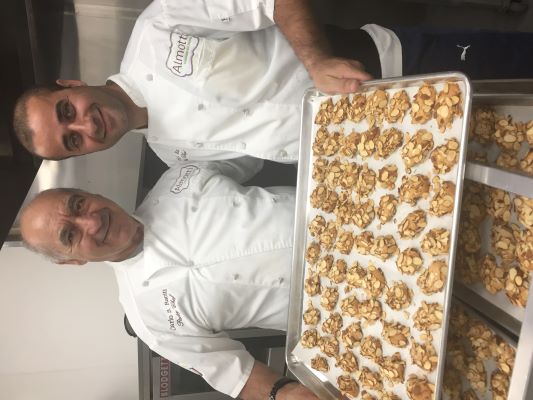
Then, I worked alongside Giuseppe Giangreco, the master baker of the product I started making: pasta di mandorla, the almond pastry cookie that’s made us so popular.
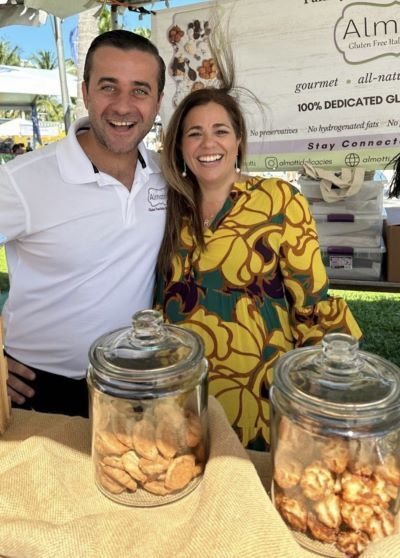
Carlo Raciti started selling at a farmers market. He now ships nationwide.
Why did you decide to focus on the gluten-free market?
These are almond-based cookies, so they are naturally gluten-free. When we returned to Miami after a year in Italy, we developed our plan to open a retail bakery.
Looking for places was very challenging. There was no Italian bakery in Miami. My wife said, “Pick the six easiest items,” and those were cookies. We decided to sell at the farmers market. It was a $500 investment, and we sold out in about two hours.
Three months later, we were doing five farmers markets all over Miami. We never went back to the original plan or made a retail bakery because we saw the opportunity to eventually become a wholesaler with our gluten-free product.
Making it gluten-free was a business decision. I’m very attached to the community where I live, and I had feedback from people that there weren’t enough gluten-free options.
We moved into a facility seven years ago, and I said, “We’ll convert it 100% and do it the right way so there is no cross-contamination.”
We became the first dedicated gluten-free bakery in Miami and South Florida in general. As we built up a clientele over the years, I started hearing the story about people getting sick with Celiac disease and so on. My daughter Lucia was dairy-intolerant when she was younger. Personally, I had a rash from eating too many processed products that contained gluten. And I realized that it was better for our clients and the community.
Many people say, “You’re Italian. Why are you making gluten-free?” But this is the reason.
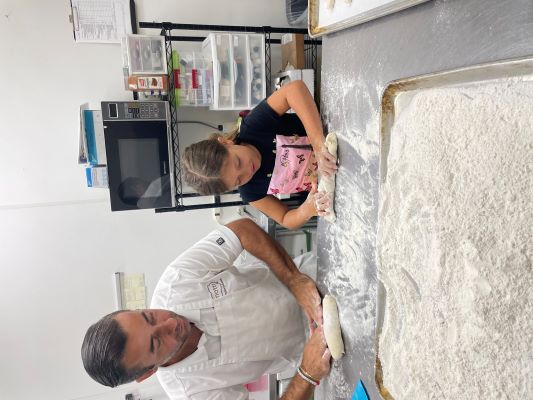
Carlo Raciti rolling dough with daughter, Lucia.
What advice would you give budding bakery owners?
Definitely get some experience, at least two to three years working in a bakery, first to understand if it’s something that isn’t for you.
If that person is going to be a baker like me, hands-on in the operation, they need to have the passion to do it because the amount of hours going through it can be very overwhelming.
It is very important with any profession that whatever you do, you do it with passion and love because you spend so much time that if you do not enjoy it, then it could be very challenging.
What are your future plans?
We’re going on 10 years, and we’re looking to grow. Going national has always been our dream. I know it’s very hard. It’s been very challenging because taking a high-quality artisanal product to a national scale where your margin is very small almost makes it impossible. But little by little, we will.
We are looking at 2025 as the year to be part of a national show where we can expose our product.
The business is our third baby; we have two kids and don’t have family around, so this has been very challenging for us. Taking care of the kids has been our first priority. And then the business. But now my son, Mario Carlo, is 13; my daughter, Lucia, will be nine pretty soon. So we can dedicate a little bit more time to the business.
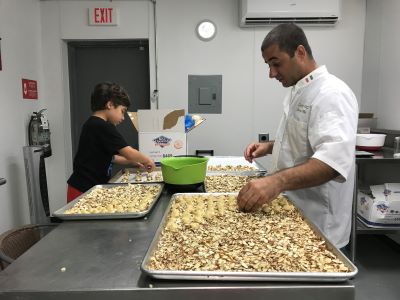
A younger Mario Carlo helping his father
What do you hope to share with customers?
Because we ship nationwide, people all over the nation have the opportunity to try my products. They connect to my childhood back in Italy, and customers can experience going to an Italian bakery because our packaging is clear, where you can see through and choose the cookie you want. They may want a cookie that is a little bit more well-done or less done. So, you can choose, and it’s like taking a trip to Italy, where people have a product that is clean with only a few ingredients, very high quality, made by hand. They can see that every single bite is different. And then they realize that it’s not just the business, it’s not just making money, it’s sharing a culture that goes over hundreds of years. The main cookie that we do goes back to the Greeks. So it’s a tradition, it’s cultural, and we want this to continue.
Artist and educator Hillary Younglove was content working on her various projects alone in her home. She’d made a career out of it. But a conversation about puppetry would change the course, igniting a new passion she had not realized.
Her friend told her about the Processional Arts Workshop, a nonprofit ensemble of puppeteers, artists, and musicians committed to creating site-specific, community-organized parades, processions, and performances in the small Northern Italian town of Morinesio. Led by American workshop instructors Alex Kahn and Sophie Michahelles, locals would come together to make large puppets from recycled materials while learning techniques such as bamboo armature construction, paper-mâché casting, and scenic painting.
The California-based Rhode Island School of Design alum and former Fulbright Scholar found the project fascinating. She decided to travel to Morinesio with her employer’s art department, theater teacher, and music teacher. They joined in the puppet-making, and on the day of the culminating event, the Midsummer Procession, she was surprised to see hundreds of people show up with puppets from past years to march throughout the town before gathering for a large dinner.
“I think it was at that moment I thought, ‘Wow, the artwork that we made is reaching all these people,’” Hillary says. “And I just loved seeing the magic in the adults’ and children’s eyes, and I thought, I want to do this. It was the start of my thinking about community art and its impact.”
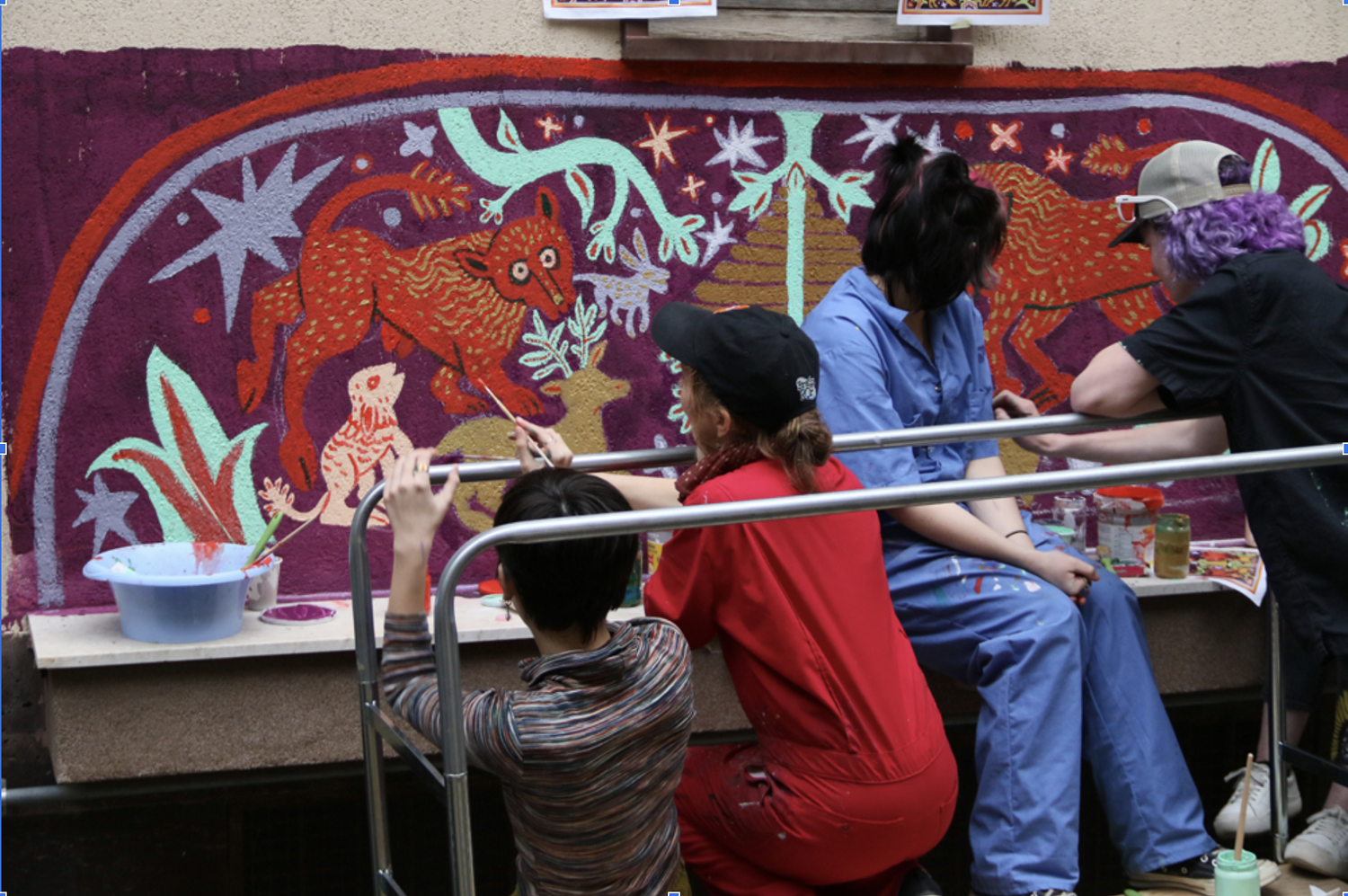
Today, Hillary proudly promotes community projects as a specialty. In 2023, she’d return to Italy—this time to Lentini, Sicily—with her Sonoma Academy students, who collaborated with local non-profit Badia Lost & Found on a mural project.
Hillary and I chatted about that recent project, its inspiration, subject, challenges and highlights, impact on the students and community, and more.
What inspired this project, and why Sicily?
We do a lot of trips abroad with the students. A couple of years ago, I thought it would be great for our students to get to know Italian teenagers. So our arts department planned a trip to Sicily. One of my colleagues, a music teacher, has family from Puglia, and he’s been to Sicily a lot, so he wanted to do an arts trip to promote his music program. And I said, “Well, if I’m going to come, I want to do a mural.”
I started reaching out to different arts organizations in Sicily, writing to them without knowing anyone. I showed them the murals I’d done, but I wasn’t getting very far. Then, I was put in touch with an organization called Badia Lost & Found, which is in Lentini. They were the perfect organization, a group of artists who wanted to revitalize a beautiful yet dilapidated neighborhood full of history. They started having local artists do murals throughout this designated arts district.
Lentini is not a tourist town at all. It’s off the beaten track, but the people love their town. They started to put these murals in, and they got a big building where they have art classes, too, for the local kids. And so it was a perfect fit for us to partner with them.
I was put in touch with Erika Puntillo at Badia Lost and Found, who spoke English fluently. So we planned something on Zoom. It was right at the end of the pandemic. I’d had some experience making murals before with students, so I knew how long it would take to do something. I knew we only had one day to do it, which was really tight.
My goal was for our teenagers to interact with Lentini’s teenagers. And so she got a local high school with an arts focus to come, and they were going to paint with our students.
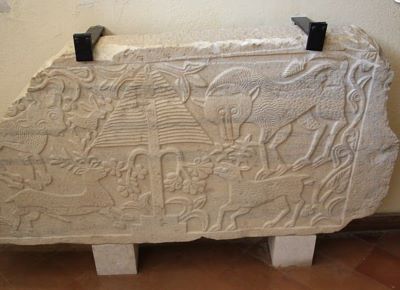
Meanwhile, I did some research because they said they wanted something symbolic that represented the region. So I started going online and visiting museums and looking at different artifacts, and I found this image that I thought would work well as a mural. It was a Byzantine image, a stone carving. I thought the simple design would allow all skill levels to participate. So I took that image and drew it, and then I had one of my students create several color variations to scale. We sent those color palettes and designs off to the people at Badia Lost and Found, and then they chose the one they wanted.
Byzantine carving on display at the Regional Archaeological Museum of Agrigento
What were some of the challenges you faced?
We had exactly six hours to paint this mural. So I asked them if they could paint the background color before we arrived, leaving us just enough time to sketch out the whole thing and paint it.
We rented a big tour bus to take the students around Sicily. When we arrived in Lentini, it was really funny because it felt like we were rock stars arriving in this little town that Americans and other tourists seldom visited. The local citizens’ heads turned as the bus pulled in. Our bus got stuck on one of the small side streets, but the locals helped us get the bus unstuck through lots of gesticulation and advice. And so we were late, and then it started raining.
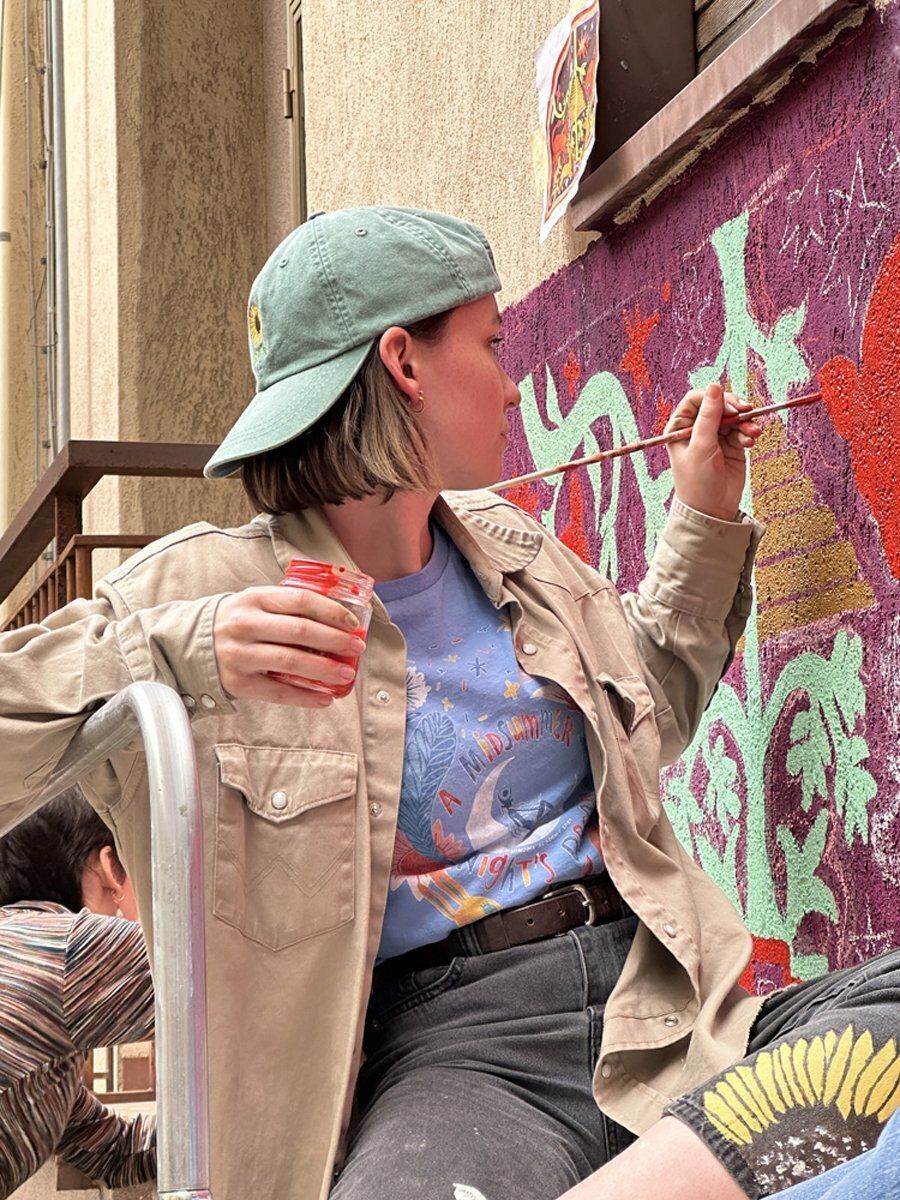
The student artists in action
Tell us about the experience when you got there.
We immediately got to work. They had their group of kids there; our kids hit it off with them immediately. It was really great. I was so happy to see that my goal had already been achieved through their interaction. As word got out in town that the Americans were painting on a side street, an English teacher brought her class over. There were tons of kids talking excitedly, exchanging stories and ideas about teenage life in Lentini versus life in California with views on art and soccer. It was beyond what I had hoped for. So I was super happy.
They also had commissioned a local muralist. She worked with the Lentini art students while I worked with mine. Our murals were face-to-face on different apartment walls.
They asked the neighborhood, “Do you want a mural on your building?” And one family agreed to have our design painted on their apartment.
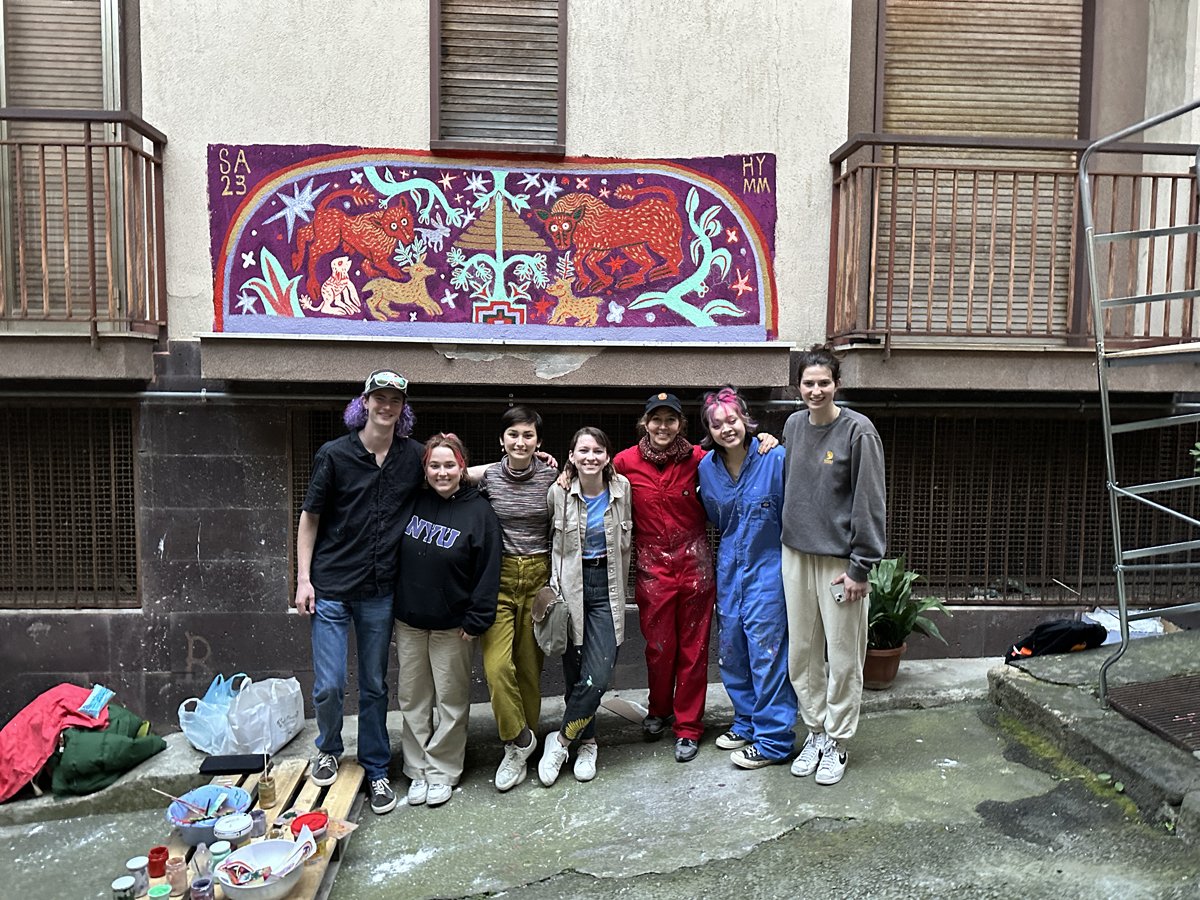
The family, with two little boys, watched the progress with excitement. We got it done just as the sun went down. So it was great because even after that day, the Sonoma Academy students kept in touch with the Lentini art students they had made friends with, and then those kids met us on the last day in Catania. It was really heartwarming to see that connection.
The artists beneath their finished masterpiece
What did you personally take away from this experience?
I’d love to do more community-based art projects so that people who don’t frequent galleries or museums have art in their lives. Art is for everyone, and everyone should participate in the act of making something creative. So, I would love to collaborate more here and abroad. It’s just a wonderful thing.
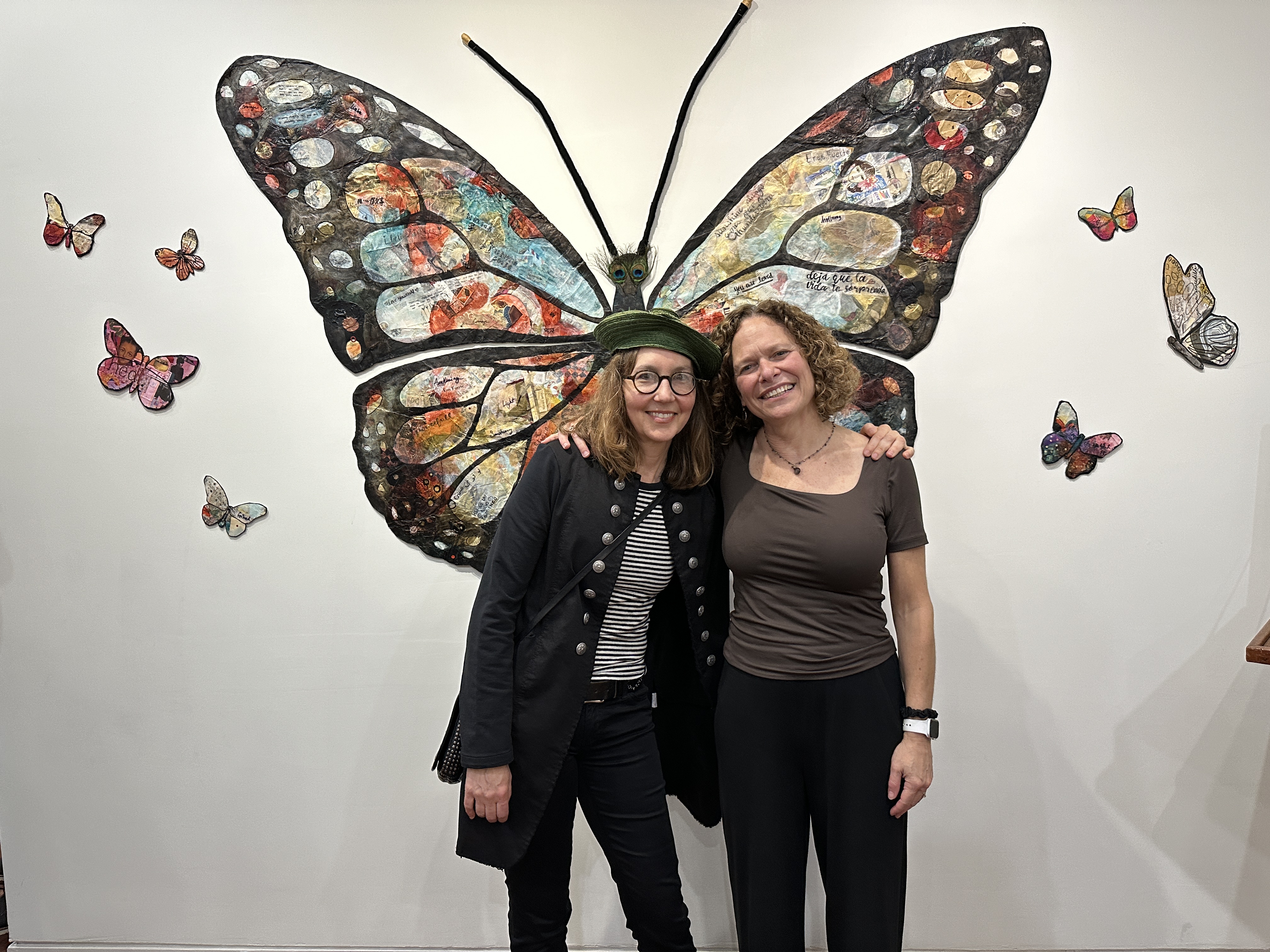
Art from Hillary’s recent Traveling Postcards exhibit
I actually just finished a project that I did for a nonprofit called Traveling Postcards, which supports survivors of gender-based violence through the healing arts. I curated a show in Washington, D.C., for the organization and went there in October to help hang the show. As part of the exhibit, my students helped with writing quotes from survivors and made collages that I turned into small butterflies that accompanied my giant one.
I’m really interested in how art is a healing and community force. And so I want to keep doing projects like these.
Jessica Tranchina’s father didn’t have it easy. Born and raised in Balestrate, Sicily, as one of nine children, he was a soccer player who didn’t have enough money for shoes. When he came to the U.S. as a teenager, he couldn’t speak English. Instead of college, he fought in the Vietnam War. Afterward, he worked as a house painter.
“He faced a bunch of hardship that he doesn’t talk about, and that just made him who he is,” Jessica says. “And so we were raised with this example of someone with an amazing work ethic.”
Her father eventually realized a passion for flipping houses, leading to owning rentals and having the money to send his whole family to Italy every two years. His grit and ingenuity inspired Jessica.
“My dad’s an Aquarius, and my daughter, Giovanna, said to me, ‘You’re also an Aquarius, so you’re a trailblazer, and you think differently than other people,’” Jessica says.
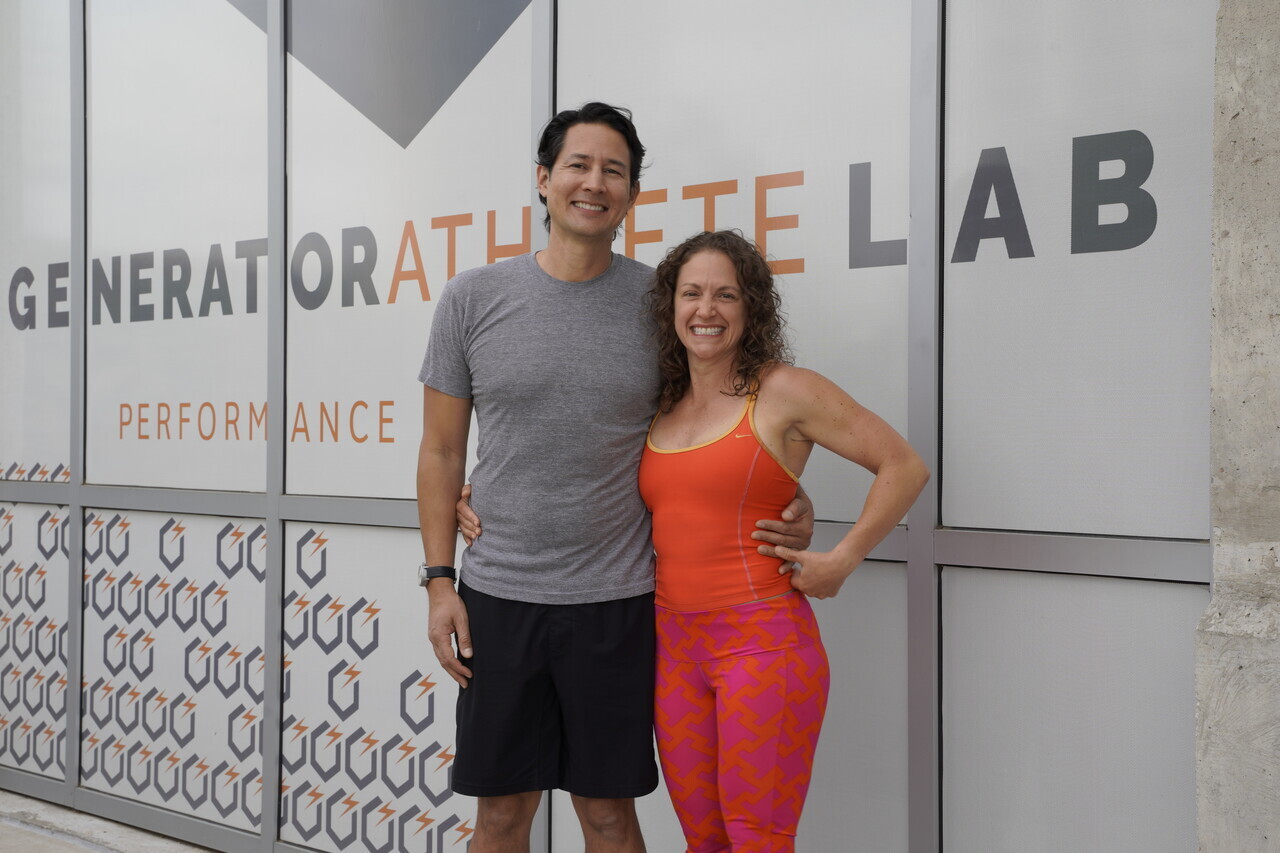
As co-founder of Austin, Texas-based Generator Athlete Lab and owner of Experts in Wellness, this doctor of physical therapy has definitely blazed her own trail. She’s also earned her stripes by competing in fitness events ranging from 5Ks to 50Ks, sprint triathlons to Ironman races, and strength challenges to figure competitions.
Jessica took time out to chat about her practice and its inspiration. She also shared her goals and hopes for clients.
You have competed in a wide range of athletic events. How have these experiences shaped your approach?
I’m an eat-your-frog kind of person. When you do the really hard thing in the morning that you don’t want to do, it makes the rest of the day easier and makes you more resilient. So, I do that in business, life, and sports.
For anything that I tackle, I do the really hard thing or the hard training, whether in athletics or trail runs and triathlons and any competition that was happening. I call opening Generator Athlete Lab in 2018 my marathon or ultra run.
It’s taught me so much about people in general, their psychology, and what makes them tick because it’s way different than what makes me tick. I’m super competitive, highly driven, and motivated. I feel like it’s served me well in life, but my biggest challenge has been learning other people aren’t always like that.
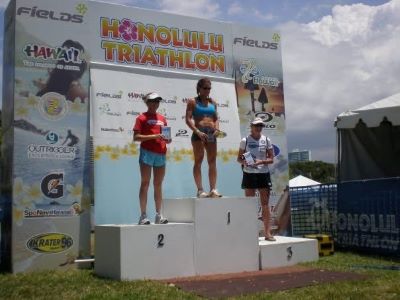
Jessica placed first in the 2009 Honolulu Triathlon.
What inspired you to create the Generator Athlete Lab?
As a practitioner, I knew early on—when I was 12—I wanted to be a physical therapist and follow the best mentors. I defended my dissertation at Boston University; I wanted the top degree. I knew I wanted to be the best.
Eventually, I opened my own practice in Hawaii in about 2006. Then, I brought it in 2010 to Austin.
I was practicing and seeing clients and would research recovery modalities and smart training. I did a lot of manual therapy and thought, “There is not a single space that exists for not just athletes to recover but also for my clients to recover and get the best manual care, training, and recovery.”
So that’s when I said, “I should build it.”
Afterward, I thought, “Wait! What if people don’t like this? This is absolutely crazy!” But when I opened it, people said, “Wow, this is crazy, but it’s working.”
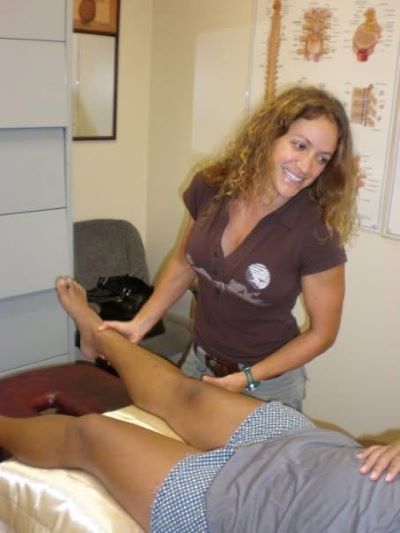
Jessica’s clients range from athletes to individuals looking to boost their mental health.
Why did you choose to focus on recovery?
It was the one thing I didn’t focus on personally. My only thoughts were, “Go! Train, train, train!”
Things started hurting for me, and I thought, “Why am I not even doing this?”
I started researching modalities that are science-backed and proven to work. They’re great for longevity and mortality, heart health, and brain health.
It’s not just athletes recovering for sport. We see a lot of injuries and people doing it for their mental health. And that has been the most rewarding part of it. I didn’t even think of how amazing that part would be.
Originally, it was for inflammation and injuries, and now, people come to get off their antidepressants and anti-anxiety drugs to sleep better and to be nicer to their kids. And that carries so much weight to me. It’s very rewarding.
Describe the protocols you and your husband, Delfin Ward, have designed.
We’re known for our science-backed recovery protocol: 30 minutes in our infrared sauna and then in our contrast—hot and cold— tubs, along with medical-grade compression garments and vibration. There’s science behind each step. We put them in that order, so when you come in for your pass or appointment, you get the full protocol we’ve designed.
You also own Experts in Wellness. Tell us about that business.
Generator Athlete Lab is zoned as medical, but we don’t do physical therapy there because we don’t want people to get confused. You can’t bring your insurance card in and use that. It has a membership model or a pack.
Since I still practice physical therapy, I’ve launched Experts in Wellness, where I hang my Physical Therapy license. I wanted to partner with a nutritionist, too, and we’re starting to offer nutrition services and blood work panels to my clients. It’s awesome.
What are your future goals?
We are going to expand Generator Athlete Lab nationwide. We’re going to partner with like-minded people with the same mission as ours, truly compassionate people who want to help. And if we franchise, we franchise. Right now, that doesn’t sound attractive to me because that sounds like fast expansion without me keeping my hand on the pulse. Our initial plan is to establish partnerships across the nation.
What do you hope clients take away?
True healing. Not just physical healing but emotional and mental healing.
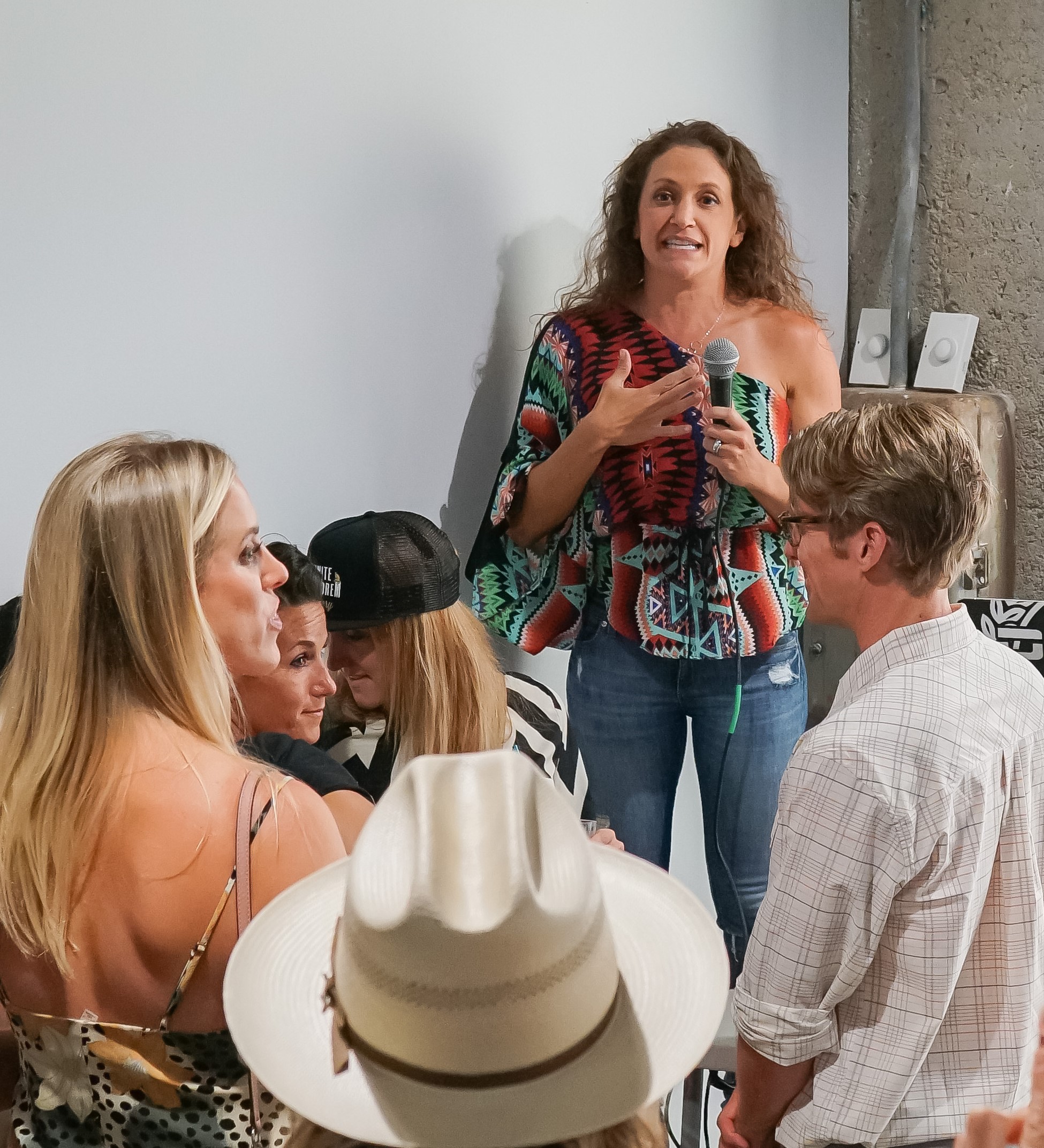
Jessica presents the concept of Generator Athlete Lab to her community.
What do you find most rewarding about your work, and how do you stay motivated?
I took off seeing clients for two years, probably the least motivated two years of my life. I’ve wanted to be a PT since I was 12, and I stopped seeing clients because I just wore the full-time business hat.
The business is doing really well, but it was not fully fulfilling me. Seeing clients really grounds me. Now that I started seeing clients again after a two-year hiatus, it has reignited every single fire in my life.
A quote by Pablo Picasso resonates strongly with me: “The meaning of life is to find your gift, but the purpose of life is to give it away.”
That quote hit me so hard when I saw it because I was not giving away my gift. I’m a healer; that is my gift. My gift is to help. And I help in a lot of different ways. I help my team, I grow and lead my team, and my team helps our members. But specifically, I need to help people: individuals.
On my first trip to Sicily, one of my cousins handed us a bottle of limoncello. I had never tried the beverage before, but I was grateful for the opportunity to taste a traditional Southern Italian liqueur. We packed the bottle with us when we left to visit my other cousins in Milan.
I did not anticipate that we would receive a second bottle from my Northern relatives, who shared a similar pride in the beverage. By the end of our trip, we had so much limoncello that I had to give it away before we flew back to the U.S. But the sweet lemon liqueur will always remind me of family.
The same holds for Phil Mastroianni, co-founder of Fabrizia Spirits, who remembers his Calabrese grandmother sipping limoncello. After a trip to Italy, where he enjoyed a glass with his cousin, he began making his own. His uncle tasted it and encouraged him to transform his hobby into a business. He’s since branched out to sell blood orange and pistachio cream liqueurs and canned cocktails.
Phil shared Fabrizia’s signature natural ingredients, why they use Sicilian lemons, challenges he’s faced, advice he’d share, and more.
What exactly is limoncello?
Limoncello is a lemony liqueur made from the zest of lemons, flavored and colored by the essential oils that are inside the zest. It’s a four-ingredient recipe with zest that contains the natural oils added to alcohol, sugar, and water.
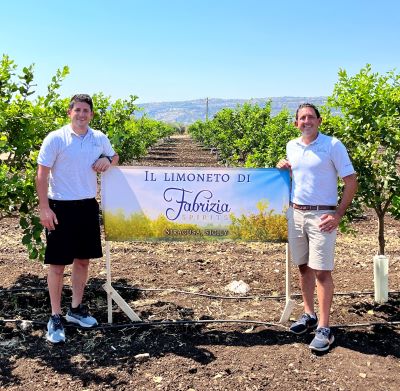
Fabrizia’s Syracuse lemon grove
Why do you use Sicilian lemons?
Our limoncello uses Sicilian lemons for two reasons. One, they make limoncello as tasty as any lemon you’ll get from anywhere in Italy. But there’s more transparency. Sicily grows 70% to 80% of the Italian domestic production of lemons.
Arabs brought citrus to Sicily between 900 and 1000 A.D. They also brought the ideal irrigation system for lemons, and they just grow well. They don’t need nets. The temperature rarely goes to freezing, where the tree could get damaged, versus if you go north to Campana, that subtle five additional degrees average temperature makes a difference.
Not only do the lemons grow in abundance, but they’re also less expensive for all the reasons I just said, and the land is flatter. Mount Etna has that wonderful volcanic soil on the island’s eastern side that really helps them. So because they are easier to grow in Sicily compared to the hilly slopes of the Piano de Sorrento or anywhere else in Amalfi, you end up having more access to the fruit.
We visited the other lemon-growing regions—Amalfi, Sorento, and even a town called Rocca Imperiale, which is in Northern Calabria on the Ionian Coast. Rocca Imperiale actually just received an IGP status from the European Union. They sell to the Amalfi Association because the Amalfi Association changed its bylaws to allow lemons from this town in Calabria simply because Amalfi cannot keep up with its own demand given the natural environment of where Amalfi is.
Sicily doesn’t have those issues. What we found is even when we visited the Sorento Association in Fondi, where a lot of the Sorrento lemons come from, there have been multiple instances where authorities have had to come in and say, “Nope, these are not Sorrento lemons. These are not Amalfi lemons. They really grew in Tunisia or Spain.” I don’t believe I’ve ever heard of that ever happening in Sicily. They’re able to grow them in abundance there on their own.
So, it is part pricing and part knowing we’re getting what we’re paying for and using Italian fruit. Ultimately, there’s no real difference in the quality.
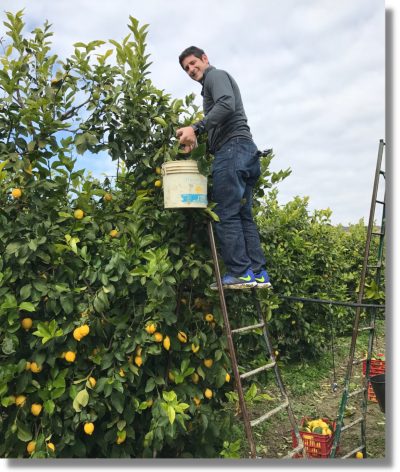
Nick Mastroianni picks lemons for their flagship product.
Why did you choose New Hampshire as your base?
I grew up in Newton, Massachusetts, just outside of Boston. All my grandparents immigrated from southern Italy to Boston. It is $10,000 a year to have a liquor license in Massachusetts as a manufacturer. In New Hampshire, it was $1,700 and still is. And this was 15 years ago. Even to do it the “right way,” you need federal and state licenses.
I was 25 when we found a place to rent, and I remember doing the math. Even up here in New Hampshire, we would have to sell almost 6,000 bottles a year without a salary, without anything, just to pay all the licensing fees and the rent where we were going to produce it. At that point in my life, I had only made about 50 bottles of limoncello.
It seemed like an absurd number: Who was going to buy 6,000 bottles of limoncello? I’m proud to say that this past year, we have hit almost 300,000 bottles in annual production, and our biggest customer is the Epcot Pavilion in Disney World. They buy over 6,000 bottles a year in just that one location. So it shows that sometimes you need to make sure that you dream big enough.
When starting, you need to take one step at a time. Had we got the licensing in Massachusetts, we would have had to sell 9,000 bottles. And that was an even more inconceivable number at the time—just to break even. New Hampshire is a small state that treats businesses very fairly and entices them to come here.
Had we been in California, for instance, we would’ve felt the need to stay California fruit forever because that’s simply what they do. At first, we were all-California fruit, and then it was fruit from wherever we could get it from—Mexico, you name it—and then we went to a blend of Italian fruits. A year and a half ago, we said, “Okay, we’re going to go 100% Sicilian,” and we have a camera on the grove we buy the lemons from.
We are producing limoncello in an authentic way. We could make a limoncello that is an 8 out of 10 just by cutting out the fake coloring and having a good recipe. Now that we’re able to get the fruit from Sicily, and we still make it the old-fashioned way, the same way they make it in Italy, we can make it a 10 out of 10, and we can do it at a better cost than the brands that are trying to produce it the right way in Italy and sending it over here.
What challenges have you faced?
We can produce Fabrizio limoncello for less because we just bring the lemons over, not the finished product with the glass and the bottles, et cetera. On the other hand, we import almost a million lemons a year from Sicily. So that has its own challenges.
The biggest challenge in the space is—hands down—getting distribution. That’s something I wasn’t planning on when I started this business. It’s taken a lot of time, but I got good at it. And we get to work with some really large liquor wholesalers. But those relationships don’t happen overnight.
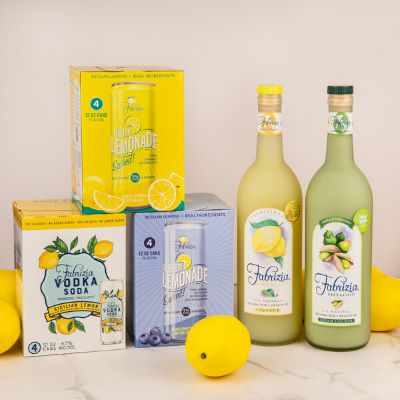
Fabrizia Spirits now sells a whole line of bottled and canned beverages.
Tell us about your blood orange liqueur and pistachio cream liqueurs.
The blood orange came naturally since its production is the same as that of limoncello but with blood oranges. One day, I was walking through Boston’s Little Italy (the North End), and a customer said, “Hey Phil, why don’t you make blood orange cello? I would buy it from you.” We started making it right after that.
The pistachio was a lot more work. We noticed an uptick in places making pistachio martinis, and especially since pistachio is popular in Sicily, where we get our lemons, it was a natural extension. With that said, creating the liqueur took a lot of formulation as there is no one set recipe.
What led to the creation of your canned cocktails?
All of the left-over lemons! When we launched our ready-to-drink canned Italian Margarita in 2018, we were throwing away about 400,000 zested lemons per year at the time. We started juicing them and used that as the base for the cocktails. Being part of the rising popularity of ready-to-drink cocktails has certainly increased the visibility of the Fabrizia brand.
How has listening to your customers influenced the evolution of Fabrizia Spirits?
Always so important to do. We are constantly listening to feedback on sweetness and taste profiles. With that said, the number one thing we hear is something we always promise to do: Be a brand you can count on to make natural limoncello and other alcoholic beverages with no fake colors or flavors ever.
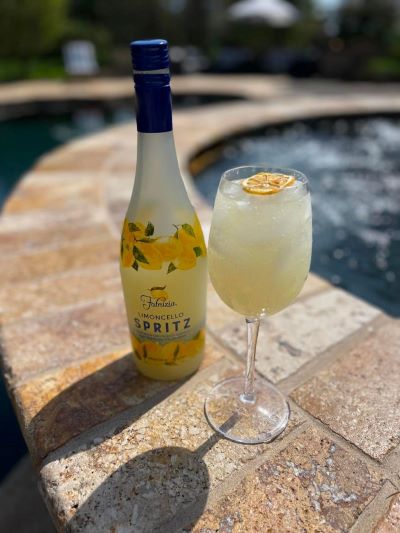
Ready-to-serve Fabrizia Limoncello Spritz
What new products or ventures excite you?
We’re looking into producing Fabrizia in Italy for the Italian market in the years to come, which would be a big achievement for the brand. We’re also diving into the deep end with a bunch of versions of bottled and canned Limoncello Spritz, made with imported Italian wine.
What advice would you offer other entrepreneurs?
If you’re going to get involved in the spirits business or start your own business, you have to really size up how big your excitement and passion are for what you’re going to do. I am more excited today than I was 17 years ago to be making limoncello.
But there’s been so much time over the last 17 years where things have not gone right, and progress has not happened as fast as we had hoped. There were disappointments of many varieties, from business relationships to the product not doing as well as we’d like to in certain places.
If you really love the idea and believe in it, and it makes you happy, well, you can sustain all those challenges. And if you don’t have the excitement or the true passion, you’ll likely find that at one of those challenges, you’ll find something else you’d rather do. Fortunately for me, that didn’t happen because I believed in the idea so much and wanted it to work, not just so I could make money but also because I really wanted it to work for its own reasons.
What do you hope to share?
When it comes to the limoncello, we always love it when it is enjoyed by friends and family together on memorable special occasions. For me, it was about my grandmother. She would have a little bit of limoncello on Christmas Eve. She didn’t drink that often, and I always found it to be a spirit that was approachable to the group. It wasn’t about drinking; it was about bringing people together.
We really hope that the experience is better for you if you are going to have an alcoholic beverage. You shouldn’t have to say, “Okay, well, on top of having a drink, I’m going to have a bunch of Yellow Number 5,” as in the case of our imported competitors, or “I’m going to have a bunch of preservatives in my vodka soda canned cocktail.” We use fresh juice in our canned cocktails.
We really want the experience to be one of enjoying all-natural ingredients. That’s what we’re hoping to bring to people.
Rachel Villa was living in Oxnard, California, working for a military child care program, and going through a divorce when a counselor asked her how she was feeling.
“Well, I’m feeling pretty crappy,” she remembers saying.
At that moment, she was facing an existential crisis. She’d been a military wife and put her career on hold, and now she faced living on her own. She didn’t know what she wanted to do with her life.
The counselor asked Rachel where she might want to take a vacation, to which Rachel responded, “You know what? I’ve never been to Europe, so I’m going to Italy.”
The counselor told her to put it on her dream board, something Rachel had never heard of. Soon, she was clipping a cartoon picture of Italy from a magazine and tacking it on a board. That push-pin dream board evolved into a Pinterest page. Eventually, thanks to a chance encounter with a friend of a friend, she found herself facing a whole new world of possibilities in Sicily: a husband, a vineyard, and a family.
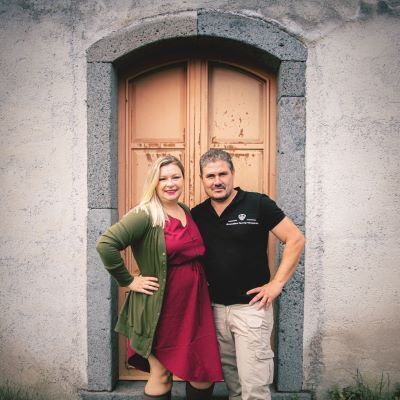
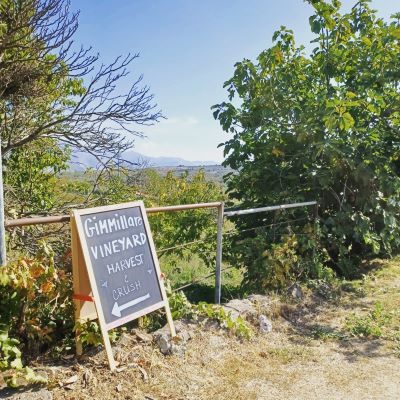
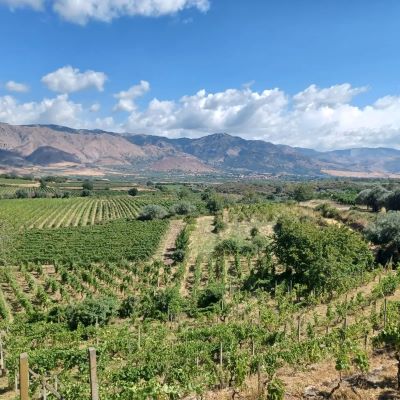
I recently had the opportunity to chat with Rachel about how her dream board became a reality and how she helped launch Catania-based Gimmillaro Family Vineyards.
What brought you to Sicily?
In another life before my ex-husband, I was in Pensacola, Florida, where my dad was stationed. Pensacola is the cradle of naval aviation and where the military trains all the pilots that we have agreements with.
During my college internship, I got a job on base that provided housing. I was there with all these other girls; we were with the officers and all these Italian Navy pilots. And man, that was fun. Every weekend, we would pile up in my Jeep and go to Pensacola Beach.
I stayed in touch with one guy (Ruggiero)—totally platonic—over email for 20 years. While dealing with this dream board, I decided to message him and tell him I was looking to come to Italy.
He said, “Where are you going to go?” And I said, “I don’t know. There are a couple of jobs available. One of them is in Naples.” He said, “You do not want to go there.” And I was like, “Well, if it gets me to Italy, that’s better than nothing!”
I applied for the job, and I got it. There were over a thousand applicants, and out of seven people, I was one who got this training position to be a manager with a child youth program.
Before I went to Naples, they wanted people to do some temporary assignments. So they sent me to Sicily at Sigonella Naval Air Station, where my friend was stationed in the Italian Navy. So I messaged him and told him when I was coming. And he said, “Actually, I’m on an assignment with the Italian Navy for the beginning of that time, but I have a friend who I can hook you up with to show you around.”
I got a message from this guy named Marco, and I could hear his accent through the way he wrote, “I hope I do not disturb you.”
I was like, “Who is this?” I started looking at his pictures, and he seemed to be in the military. And I was like, okay, so this is probably Ruggiero’s friend. So I told him when I was arriving, and he offered to pick me up. And I was like, “No. My boss is picking me up, but just meet me at the residence.” And he was waiting for me there. He was there every single night for the next 90 days.
Apparently, I had a boyfriend. Within 10 days of meeting this guy, he took me to meet his mom. And after 90 days, I had to go back to the States, and I was like, “I have a boyfriend in Italy. What am I going to do?”
I was not looking for it at all. I just was looking for an adventure. But gosh, I found a man.
He kept saying that he was a farmer and worked as an agricultural scientist, which was his degree. He was telling me some things about that, but I didn’t ask many questions. I was not taking him seriously. I wouldn’t say I didn’t care. It was about me. It was me-time.
So, I came back to Oxnard and realized, “Wow, if I don’t go back to Sicily, I don’t know what we’re going to do. This is going to be a crazy long-distance relationship. I’m going to have to go back and forth from Naples to Sicily every so often to see this guy. Is that even a relationship? Do I want to do that?”
During this training period, which took about a year, I ended up going to Key West, Florida, and everywhere else except Sicily. I finally decided to take him seriously as this relationship was progressing.
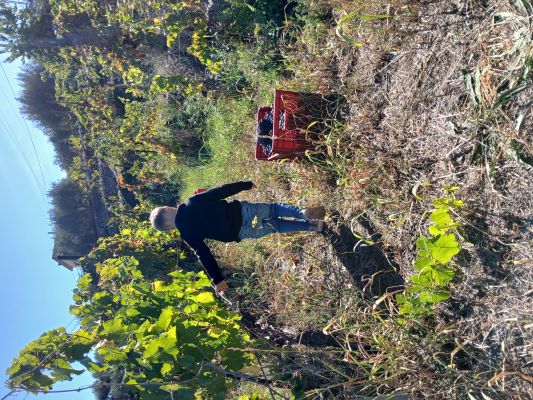
I had no idea that every time he went to a vineyard, it was his. I came to visit, and it was in October of 2017, and he took me to one of his locations where he was going to be doing a vendemmia, which is a grape harvest; our mutual friend came down, and his sister was there, and all these people he knew came. And I was like, “So whose farm is this?” And Marco was like, “It’s mine.” And I was like, “We have been together for a year. How did I not know that you had a vineyard?”
He said, “I don’t come here very often. We just came for the vendemmia, and I trim the branches throughout the year and tend to the soil, but this is my vineyard.”
I suddenly felt really out of my league and started getting emotional. And I said, “Marco, I don’t know if this is going to really work because I have been a military kid my whole life. I move a lot, and I’m going to go to Naples, and you’re here, and that’s a lot of back and forth, and I just don’t think I can do it. I need somewhere where I can plant my roots.”
He literally bent down into the dirt. He picked a little bit up, held my hand, and said, “Plant your roots here with me.”
Tell us how the vineyard evolved.
It was just a plot of land he was making patronale with, like garage wine. It’s what the locals make for themselves.
As a Californian, I had a little knowledge of what people want when they go to a vineyard, especially somewhere like Santa Ynez Valley or Temecula. We’re expecting meals, a beautiful wine tasting, and sometimes just a flight and just sitting there and enjoying the view. But definitely some customer service and a learning experience.
One of the things I noticed while doing some reconnaissance wine tastings around here was that nobody was having people come and do the harvest just for fun. There were opportunities to do a grape stomp, but nobody was being allowed to do real hands-on. And I thought, “Why is there some legal reason?”
Marco looked it up and said, “Actually, there is a legal reason. There need to be ‘tutors,’ and the work must be declared.”
And I was like, “Well, how do you declare this work?” Marco explained that it would need to be a “demo.”
I said, “So, we can do it. We’re not going to get in trouble if we have people come, and we could even give them a barbecue.” He said, “Correct, because the product is separate from the main production. Then they’ve done the work, and we can show them how to make a patronale.”
I was like, “Oh, Marco, Americans would love that!”
And so we’ve come up with this from the reconnaissance and knowing nobody else was doing any kind of meaningful hands-on at the level people really wanted. Having a tour of a beautiful vineyard and a beautiful winery with all this professional equipment isn’t educational. It’s a tour of something already established and expensive. But people who want to know how to grow and produce wine are not really learning how to do it. So we came up with a year of vinification, a year of wine, which is all the processes.
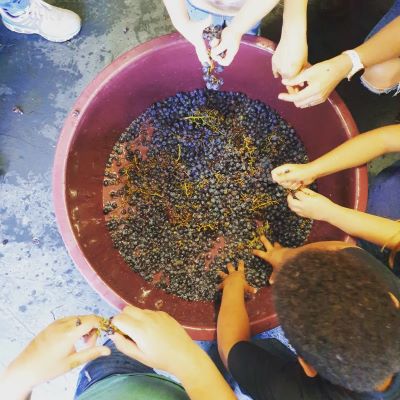
So we have a harvest. It starts with that. We bring people out, they harvest, and we separate, we squish, and then we transport to the place where we do the vinification with those people, and then we give them a barbecue.
The next process is turning the grapes, the maceration. When it’s in the containers with the skins, you can’t just let it sit there; you have to move it around. Could I make an event out of that? Possibly. We haven’t yet.
Then, the next process is moving the liquids to the travaso and then bottling, and it still has to sit in the bottle for a while. So, I thought, “I’ll have another event where we do a wine tasting, and we invite the people that came to the vendemmia and say, ‘Let’s go bottle your wine, and we’ll have a party.’”
We had a wine bottling event, and about 12 people showed up. Five of them had been to the vendemmia before. They absolutely loved the thought that their effort had gone into the bottles and the liquid they were bottling.
We let them do the hand bottling because we didn’t have the machine. We just filled it up with a tap, and it dripped everywhere. It was such a mess, but everybody had the best time!
After the fact, I thought, okay, what do people really like the most? Did they care about the food? No, they cared about the experience they weren’t getting anywhere else. And I was like, “How can I turn this into a moneymaker?”
What challenges have you faced along the way?
It’s been a process of trying to find out how I can market this because if I deal with just Italians, there’s a lack of interest around here. The foreigners are where I am focusing, especially the people from the base here, who speak English, and I know what they want. The problem is they require things that most tourists or expats wouldn’t because they live here and they have to deal with the roads. And some of them are very homebody. So I was like, “Well, I have to rent a van or get a bus and have an event. And I’ve got to calculate that into the cost of the whole thing.”
I did a vendemmia with 60 people. I had a 30-person van and another 30-person van. I had to eat the cost because 15 people didn’t show, and I still had to pay for that or otherwise ask the other people to pay more after the fact. And that was like, “I’m not going to do that.” I’m learning on the job.
We finally have a vintage. We have a 2022, and we lost all of our grapes at our primary vineyard in 2023 due to a fungal blight, but we had a secondary vineyard that we bought grapes for as an experiment, so we technically have a 2023 as well. We are not going to label it. We’re going to keep it a patronale because, legally, it’s not registered on our land, so we can’t sell it that way. We can sell it as a patronale, though.
So we technically have two vintages, and this year, we’re going to have a white. And I’m trying to stick to the guns here and be a completely bio vineyard. It makes your job exponentially more difficult. You’re highly volatile. Your processes have to be dead on. There are certification processes and criteria that need to be adhered to in order to qualify.
White has been very hard. We’ve lost it every year for the last five years. It gets skunky so fast. The summers have been unusually hot. We don’t have a temperature-controlled environment, and we are off-grid, which is again part of our process of having a bio vineyard. This year, we are working with a nearby cantina to be sure to follow the white properly.
We could get a business loan, dredge the land out, get some water flow from the city, have a sewer line put in, and do some irrigation, as well as all the things we need to have what the other big vineyards are doing. But we’re trying to be off-grid to show people that it can be done and can be done well. A lot of times, when these producers grow their production, they just abandon those simpler ways in favor of the more efficient industrialized vinification styles. And while those are great, we’re just trying to be as authentic and practical as possible.
What are your plans for the future?
We are working up to more events as we develop different wines. For instance, we want to do a sparkling wine in the future. Of course, we want to keep the demo vendemmia. The best way to teach people about wine is to let them help create the basic/patronale wines and also let them work on the vineyard.
We have hosted several groups from the Sigonella base to volunteer their time for community service credits with their command. They come on weekends and prune or plant cover crops on the terraces. Not only is this helpful for the vineyard, but it’s also a way to get our name out there as a place where you can really learn about the wine industry.
What experience do you hope to share?
The ups and the downs. I want people to see that it doesn’t mean you’re wealthy to have a vineyard. It just means you’re putting effort into something and trying to make it great. And sometimes, it fails. And what is the outcome? I’m going to try to pull myself up like they say, “by my bootstraps,” get back up, and start going and keep it going. I’m not giving up.
A lot of times, people just think that every year, the wine’s going to taste the same as last year, even though you have these wine tastings, and everybody says, “This is 2022. It has more berry flavor; these are the same grapes on the same land. This is 2023, and it tastes woodier, blah, blah.”
It does taste different. I can’t even explain why it tastes so different from one year to the next or why we have the same grape varieties. They’re separated by three miles and taste completely different.
It’s a beautiful thing, and I can see why people get so wrapped up in wine and everything about it. It’s a challenge, and it’s unbelievably rewarding. It is a science and an art. And then again, it’s farming, so it’s extremely volatile.
People have so many little experiments up on Etna. We are friends with this neighbor, and he’s trying to make a sparkling out of a grape that nobody would’ve made a sparkling out of before. And he is like, “I’m going to do it. It’s going to be amazing.” And I love that positivity.
So when I have people come, and I am showing them all the work we’ve done, I’m not here for the applause. I’m here because it’s like when I was a teacher, and I had a child that was very difficult, and other people were just constantly giving up on this child. How cruel is that to just give up on a child? It’s finding that path out and finding another direction to do something. And that’s what makes wine special: everybody has a different process.
Hailing from a small town in the Sicilian province of Agrigento, Rome-based artist Daniela Bracco has made a name for herself with her unique fusion of digital and traditional illustration techniques. Each piece of work tells a story, drawing from the beauty of her environment and the people she encounters.
“I am very attracted to nature and its forms,” Daniela says. “My illustrations come close to figurative, alla vita reale, but I always try to say something, offer a different point of view, or focus on something rather than another.”
Opposite most artists, Daniela started primarily with digital illustration before transitioning to colored pencils and brushes and combining both techniques.
“For me, it is always a discovery,” Daniela says. “Having a blank sheet of paper in front of me means starting a new journey, a new adventure that I don’t know where it will take me.”
Daniela and I connected to discuss her work and inspiration further. She shared her view of illustration’s evolution, advice for emerging creatives, and what she hopes resonates with viewers.
What are some of your favorite projects that you have worked on, and why?
I am very attached to different projects. Certainly, the work I did in the monthly magazine of Il Sole 24 Ore (an Italian newspaper) was very important for me because I had the opportunity to work with many professionals who taught me so much.
Then, I am very attached to projects that enhance the territory and food, such as the illustrations I do for the newsletter of Domenica Marchetti, a project I have followed for years and feel very close to.
How do you find inspiration for your illustrations?
For my illustrations, I look for inspiration from the world around me. I really enjoy going around and observing people, environments, and landscapes, photographing them, and then incorporating them into the illustrations.
It also depends on the themes I have to illustrate. Of course, there is also a lot of visual research, artistic or otherwise.
How do you see the role of illustration evolving?
Definitely, this is a good time for illustration. There was a time when photography was the only visual language you found in newspapers and magazines. Now, you also find illustration is a different language from photography. It has a great potential for expression and storytelling, and that’s why it’s spreading a lot.
Digital and the tools available today have flattened, in my opinion, the expressive power of this language; you often see a lot of similar illustrations. However, I am convinced that, on the other side, some really experiment a lot and well and take this visual language into worlds where no one has ever been
What advice would you give to aspiring illustrators?
It is difficult to answer this question. However, I would say to be patient and don’t give up. If this is what you want to do, do it. It won’t be easy, but if it’s what you want, you’ll get it because you can’t help yourself, and it will always be worth it.
What do you hope people take away from your art?
I’m convinced that in any form of art, everyone sees what they want to see. It can be something exciting or irritating or simply a moment when you stop and give space and time to your “sensitive eyes,” which puts you in touch with the sensitive world that today, in today’s hectic everyday life, becomes more and more distant.
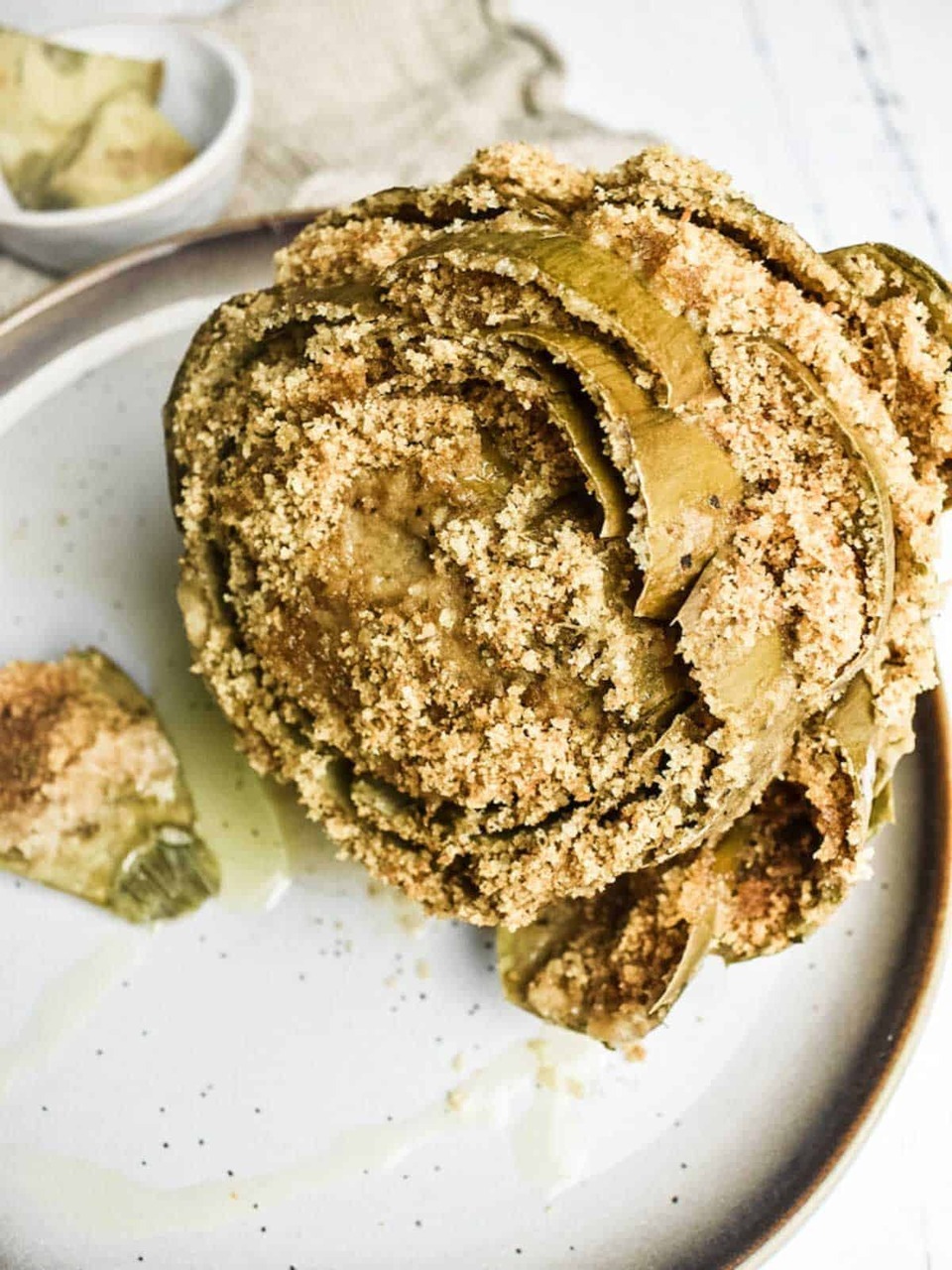
Meghan Birnbaum has been sharing food as @meghanitup since March 2020, when her newly remodeled kitchen provided the perfect backdrop for showcasing recipes. Many of these dishes and desserts were inspired by her Palermo-born grandmother’s culinary creations. Meghan’s favorite? Stuffed artichokes (carciofi ripieni).
“They were a meal, and we each got one, except my dad and I would share one,” she remembers. “He would always give me the heart; it’s so symbolic. He gave me his heart, and that’s the best part.”
Through her “Authentic Sicilian Stuffed Artichokes” recipe, Meghan hopes to share the love. We recently chatted about her rendition of this traditional dish, sourcing ingredients, selecting and preparing artichokes, the best way to cook these vegetables, and more.
Tell us about your grandmother and how she inspired this recipe.
My grandma came through Ellis Island with her dad and her mom and then moved to St. Louis. She had two sisters and a brother. Her brother went to World War II and didn’t come home; it was just her and her sisters. They each bought a house, and the backyards all backed up into each other’s, so they essentially shared a yard.
My grandpa was a sheet metal worker, and my grandma was the cook of the family. She had four kids. She didn’t know how to drive. She never had a job. She just took care of the family.
She watched me as a kid while my parents were working. My grandma didn’t write down any of her recipes, so I am recreating everything my family and I remember based on taste, smell, and feel. It took me a while to get this recipe down.
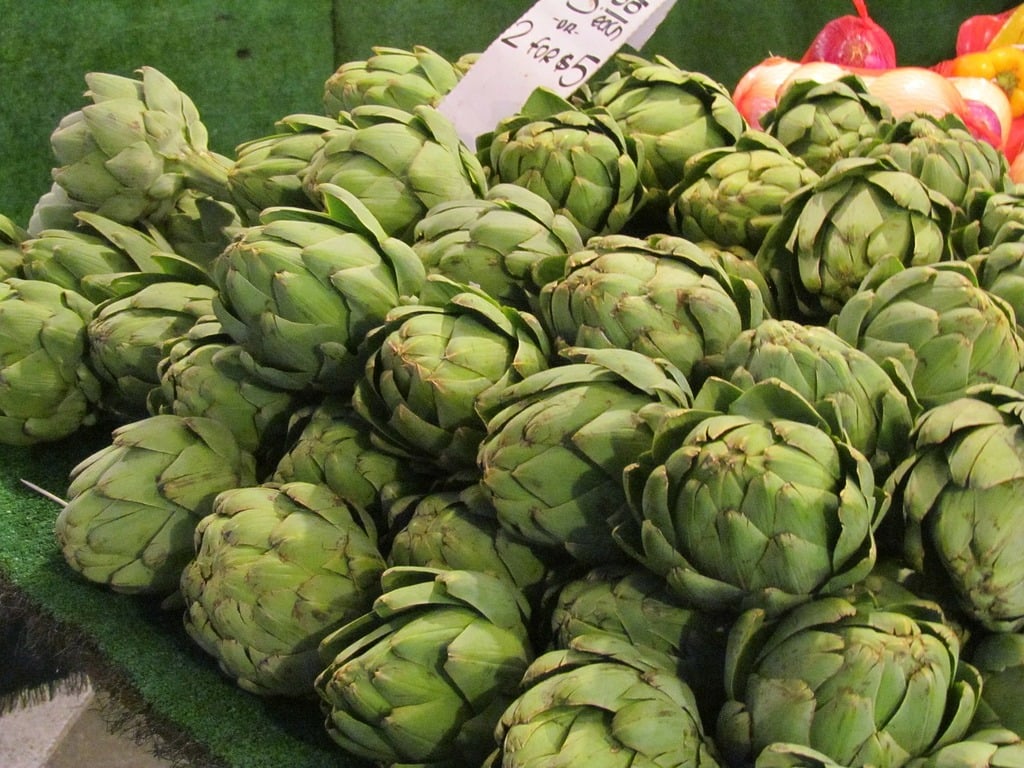
Peak artichoke season is June through September, but supermarkets carry them year-round.
How do you source your ingredients?
Living in Southern California has many advantages. We have many great farmers markets, and then we have Eataly. That’s obviously not available to everybody, but I mean, there are a lot of stores; even in St. Louis, where I grew up, there’s a little meat market called Mannino’s. It’s an Italian market, and you just start talking to people about their connection to Italy. They’ll tell you, “These are the best breadcrumbs” or “This is the best bread.”
How do you select artichokes?
You’re going to want a big, round artichoke. And if the leaves have kind of moved away from the center, it’s going to be even easier to make. The tighter and the smaller, the harder it is to prep and stuff. The bigger and more bloomed, the easier it’ll be to do that.
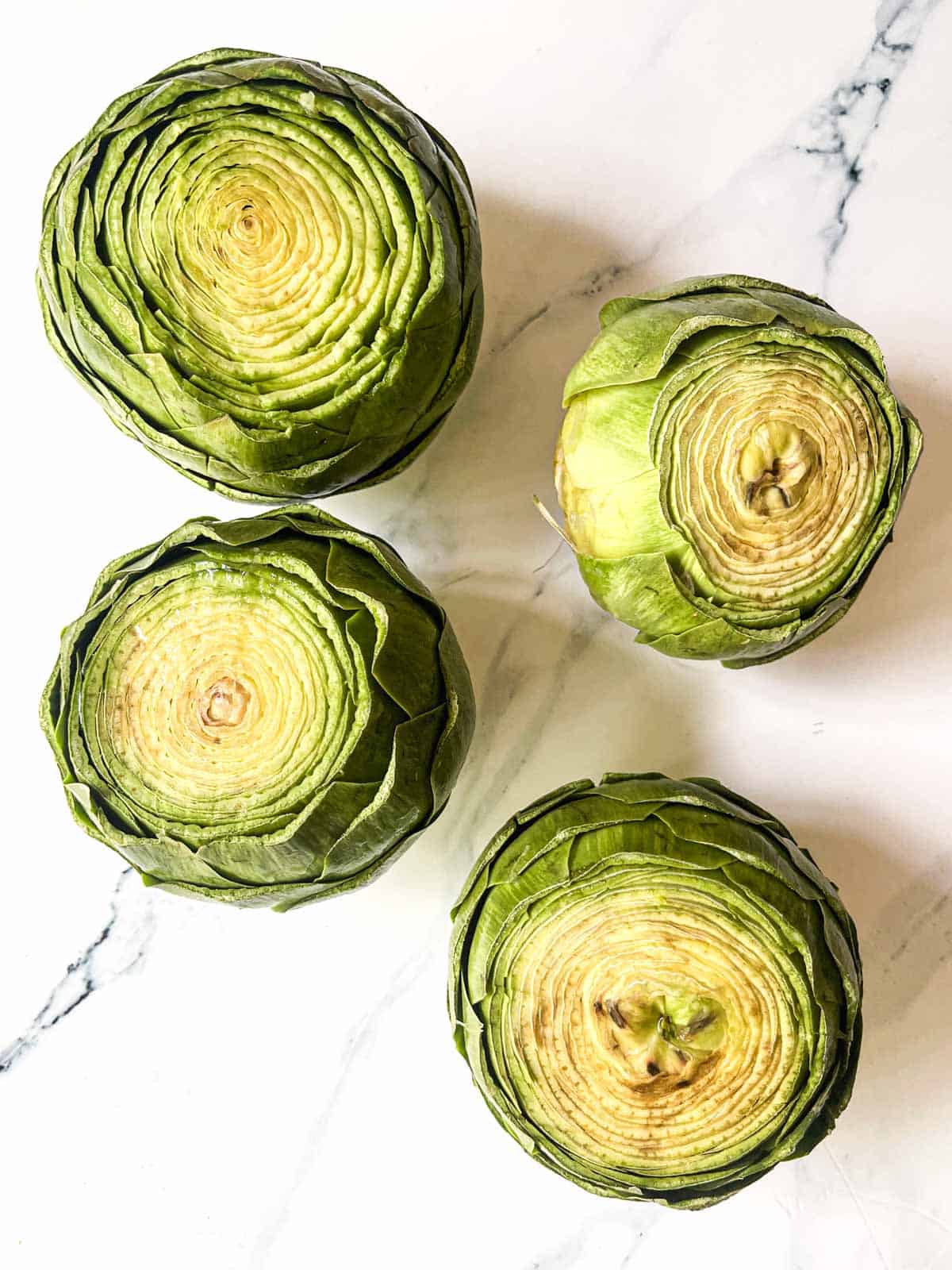
Trimmed artichokes photo by Meghan Birnbaum
Walk us through how you prepare the artichokes for cooking.
Having the right tools is really important. When I prepare artichokes, I use three different kinds of knives and a peeler. You also have to trim the leaves, so I use scissors.
I use a pretty big knife to cut the top off. You want a sharp, heavy-duty knife. It’s pretty tough to get through, and it’s not stable because the artichoke is round and on its side. You want to have something that can cut through pretty well. Then, I use a paring knife to cut the bottom and a peeler to thin out the skin on the stem.
I recommend a bucket or a bowl of water with lemon juice in it to prevent the artichokes from browning. The artichokes will brown regardless of what you do, but this minimizes that.
It’s kind of labor intensive, but I feel like I’ve gotten it down and find it very therapeutic. The more you do it, the easier it becomes. But preparing the artichoke is definitely the hardest part because of how many steps and tools you need just to get it done.
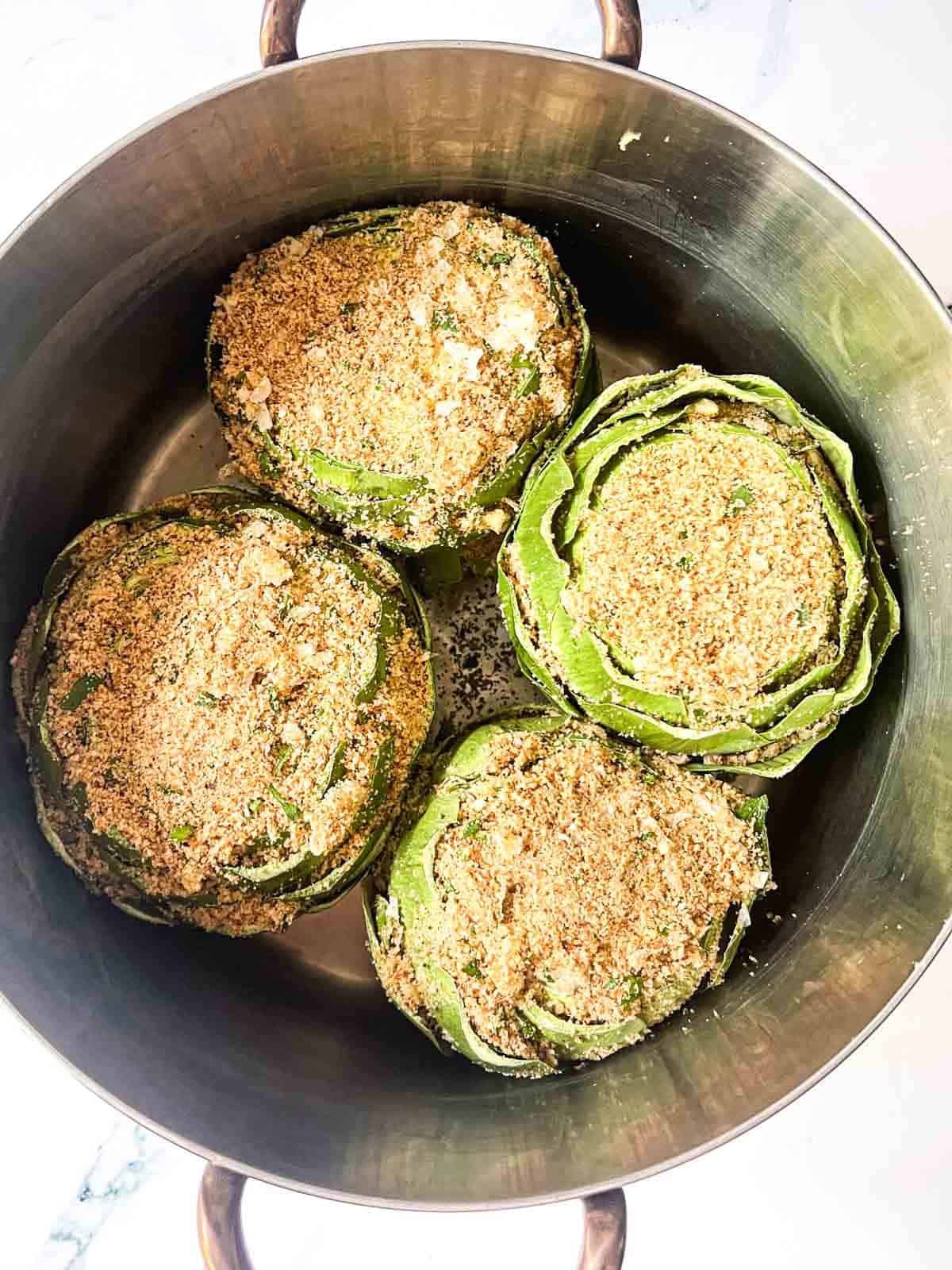
That gets rid of all the prickly parts except for the heart, which is difficult to reach. If somebody tells you to remove the heart and the center of the artichoke before it’s cooked, I don’t know if they’ve done that before because it’s really impossible. You should steam it for 10 to 15 minutes before you use a spoon to remove those parts.
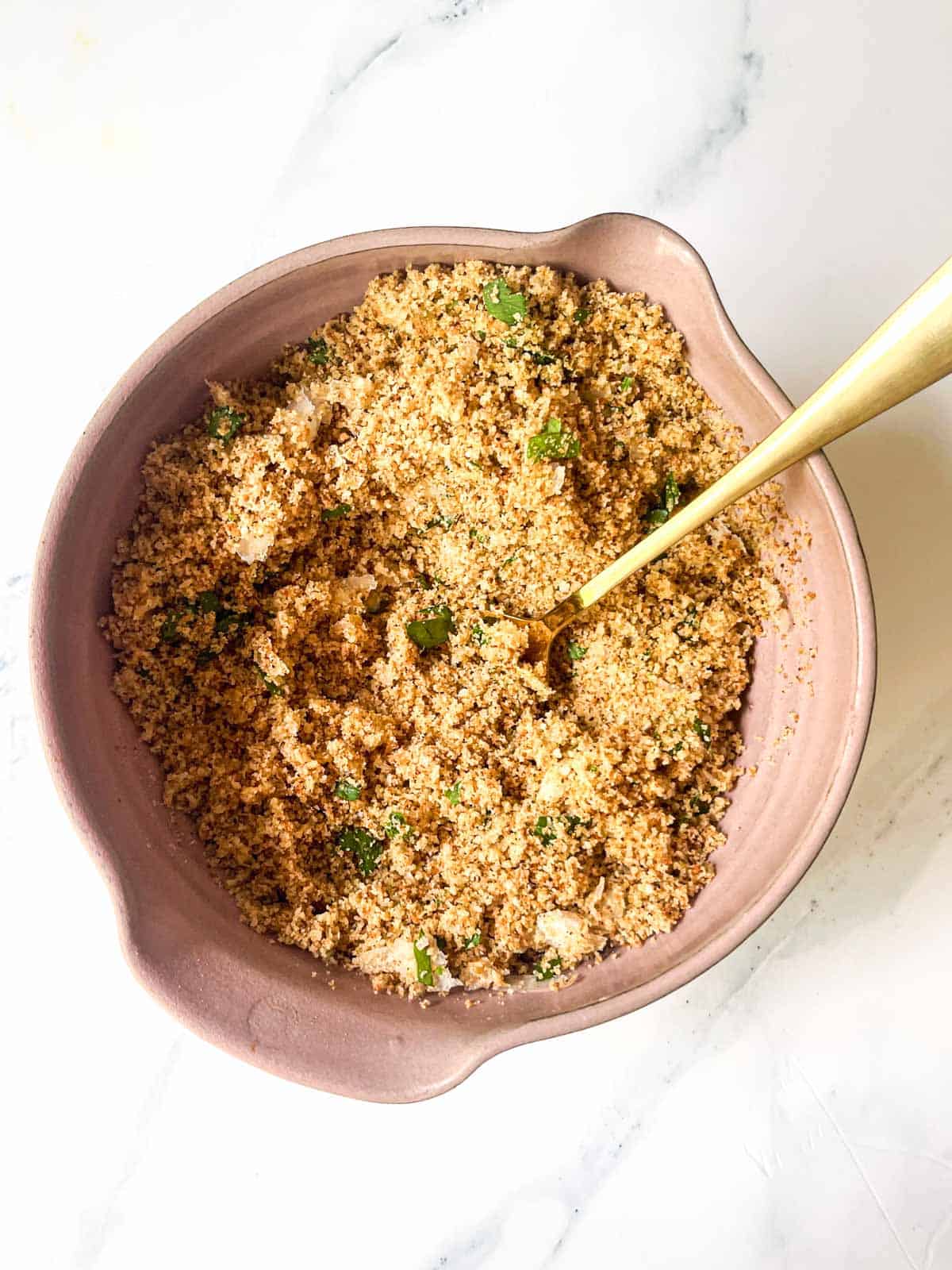
Breadcrumbs make this recipe Sicilian. Photo by Meghan Birnbaum.
Do you have any tips for preparing the artichoke stuffing?
It’s truly just garlic in olive oil until you can smell it, and then I put in the breadcrumbs. It has to be on a medium to low heat, and you cannot walk away. You need to just constantly stir. The second you see color on those breadcrumbs, you kill the heat and keep stirring. It’s going to keep browning.
Add two inches of water to the pan. Photo by Meghan Birnbaum.
What’s the best way to cook stuffed artichokes?
My favorite is just steaming them, and I’ve done it a few different ways. Sometimes, when I steam them, the water rises too high and kind of goes over the top, so the breadcrumbs on the top become mushy, which is fine. It’s mushy on the inside, too, and that’s a good texture. So if one batch boils over and it gets mushy, I’m still going to enjoy it. But I love it when I steam it just enough that it doesn’t get to the top, and the top is still brown and crispy. When it’s gotten mushy on top, I put it in the oven afterward to crisp it, but it’s kind of a lost cause at that point if there’s too much water on the top of the breadcrumbs.
I have baked before. That was a more fool-proof method. If you want to make sure you just get crispiness on it, you just put a little water into the pan, and then it’ll steam and bake at the same time.
What do you hope people will take away from this recipe?
It’s an intimidating recipe, but it’s also one that you just don’t find in restaurants. So I hope that people will feel encouraged to make this and know that they can make traditional recipes that are not restaurant recipes but rather home recipes.
It uses fresh, homegrown ingredients with very Mediterranean vibes. Homemade bread does not go to waste because you’re grinding it into breadcrumbs. You’re also really utilizing the harvest of the olives and the olive oil. It is like a little Mediterranean treat using what the resources and the produce available have to offer.
The deadliest hurricane to strike the mainland U.S. since 2005’s Katrina, Helene caused widespread and catastrophic damage, wrecking thousands of homes in the Tampa area alone.
“Our whole home was flooded,” says Tampa-area resident Victoria Mahdieh, who counts herself among the luckier ones. “Our cars were totaled, and we lost almost everything. It’s been a journey, so I’ve had to start from scratch.”
But she wasn’t about to lose her business. For the past decade, the owner of SugarBar Tampa has baked and decorated custom cookies and cakes out of her cottage kitchen.
Sure, she had to buy all new appliances. And she’s had to scale back a bit; she doesn’t have the same room in her new space in Carrollwood.
But it’s temporary, she says. “We’re building it back little by little.”
Victoria is used to facing challenges. She built her business from the ground up, doing everything from baking and designing to packaging. She’s grateful for the help of her family, who has pitched in on many occasions, like that time when she baked 1,000 cookies for the Chamber of Commerce, and they acted as an assembly line.
She may have inherited her drive from her great-grandparents. All four came from Sicily. One great-grandfather became a land developer, learned English, and became Ybor City’s first Italian councilman. And one of her great-grandmothers rolled cigars when she was 14, standing on a stool at one of the town’s many cigar factories.
But it’s her paternal grandmother whom she credits for shaping her into the baking businesswoman she’s become. Victoria shared more about her hero, her journey, how she ensures her baked goods look and taste good (not an easy feat!), how she engages her community, advice for budding bakers, and what keeps her motivated.
Tell us about how your grandmother inspired you.
My grandmother was the best Italian cook you’d ever know. And I used to kneel on a chair, grating cheese, as she cooked pots of sauce and meatballs on Sunday afternoons. I always watched her in the kitchen and still have many of her cooking utensils. The most precious of which are the heart-shaped cake pans she used to make my birthday cakes as a child. I use them often.
She was a huge nurturer, and I inherited that gene from her. She always expressed her love through the food she served. So that definitely was part of our household and still is.
She once made 2,000 meatballs for the Tampa Boys Club. She always baked cakes and goodies for the Catholic Women’s Club and many school fundraisers and events. And I’ve always loved to do that kind of thing as well. And I always went in a little “extra” for my kids’ birthday cakes when they were growing up or making pizzas with their classes on career day. So, it kind of went from there and developed over the years. Also, my husband and I were in the restaurant business for many years, so it’s always just been in my blood.
Tell us about that journey from restaurants to baking.
It pretty much happened organically. When we left the restaurant business, my husband opened a small car dealership. My oldest daughter became engaged, and her friends started getting married. I would make their cakes and decorative cookies for showers and parties. At some of those events, people asked if they could order from me, and I thought, “Wow! People will actually pay me to do this.”
Then we started doing markets and trunk shows, and it just grew from there. Now, it’s a regular full-time business. I’m doing something I love to do, and I get to create and make people happy.
How do you ensure your baked goods are both beautiful and delicious?
I just use the best quality ingredients and recipes I’ve developed that work best for me. With some designs, I ask myself, “Why did I say I could do that?” But somehow, with prayer and perseverance, it always works out. So, we keep on going through trial and error. When some things don’t work, you just start over and do it again.
I’ve learned to say no to things I don’t enjoy doing. Covering cakes with fondant is one of them. I love to make accessories with fondant, but I prefer covering them with buttercream. So, that’s what I do.
The designs just come from the inspiration of the theme, methods I’ve seen and tried, the client’s wish list, and what they envision it to be.
What have been your most memorable creations, and why do they stand out?
There was one: a four-tier wedding cake that I had to deliver to a hotel in Channelside. It was pouring down rain, the wind was blowing, and the whole time, I was thinking, “Oh my gosh, how am I going to get this cake in there safely?!”
When I got there, the sun came out, and suddenly, a strong and tall valet was standing behind me and said, “Can I help you?”
It was like God sent him to me that day, as he helped me carry that heavy cake all the way to the banquet room and even helped me situate it on the table. Mission accomplished.
How do you engage your community?
Just by putting out a good product and being approachable and friendly, I now have a great customer base who just keep coming back and referring their friends. The best way is word of mouth. So if you put forth a good product, business tends to come.
Several customers have been with me since their children were small. And one of them just turned 13. It’s fun to watch how she’s changed her style as she’s grown up from a little girl to a teenager. It’s also fun to follow people from engagement parties to bridal showers to weddings, baby showers, gender reveals, et cetera.
What advice would you give someone starting in the baking industry?
Just keep trying. Go forward. Don’t be afraid to take risks; just do it.
Things tend to fall into place. Do your best and use the best ingredients you can find and learn by watching videos and learning new and different techniques. Go to marketplaces and try to get yourself out there so people get to know you. Don’t be afraid to give a few things away; it helps to engage people and lets them try your product. If I have a new product or flavor, I will offer a taste when they come to pick up their order. Nine times out of 10, they end up placing an order for it the next time.
I would also trade products at one of the markets. I would trade my baklava for organic honey from a local vendor and share things with others. It gradually comes together.
What keeps you motivated?
The joy it brings people makes all those hard hours worth it. There are many 14-hour days, Christmas, graduation, and other seasons that are so busy you barely have time to breathe. But knowing that it’s bringing people joy and putting smiles on their faces makes me happy, too. That it made their event that much sweeter is the icing on the cake.